Showing posts with label Portraits. Show all posts

A Lovely "New" Portrait of Anne Boleyn


Some of you may remember how opposed I was to the “new portrait of Anne Boleyn” that surfaced a few months back. A new miniature portrait was brought to my attention via Facebook today, and I wanted to tell you why I think this one actually could be a portrait of Anne Boleyn, or at least a copy of a portrait of her.

    The owner of the portrait wrote in her post:
  Last year my husband purchased various snuff boxes etc at a local auction. In amongst them was a small portrait. I took the portrait out of its leather and velvet lined box and written on the back was written A Bo.... ( or A Bu....) and on the next line AD 1530. There is also a date at the bottom which appears to be 1796. I have been advised that it is probably not by a professional artist and that it is based on a print held by the British Museum from the early 1800's but it is dated earlier than that. It probably is based on another portrait. What there is no doubt of it is very similar to other supposed pictures of Anne Boleyn. Also, that in 1796, over 200 years ago, the artist probably believed this was Anne Boleyn?
    The date “1530″ on the rear was probably the artist’s guess as to the year the original image was created, but is probably just that - a guess. If the image does portray Anne in 1530, it would be two years before she married Henry VIII.

Unlike the portrait of Lady Bergavenny, the sitter in this portrait is wearing the appropriate clothing and jewelry for a woman of Anne Boleyn’s time-period and station. I would suggest that the date is closer to 1535 than 1530, though, simply because of the shortness of the lappets.

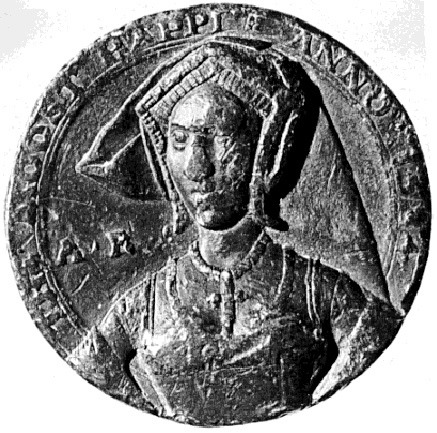
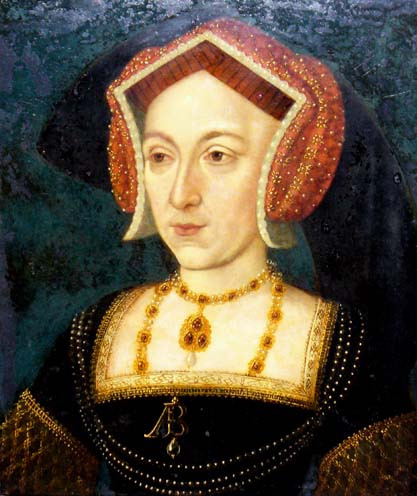
    The headdress closely resembles the one worn in Anne’s Nidd Hall and portrait medallion images.


image
image

    The lappets on the hood reach to about mouth-level which would be correct for the mid 1530s.

    The date on the back of the portrait is difficult to distinguish (at the bottom of the frame) but 1796 seems correct, stylistically speaking.


image

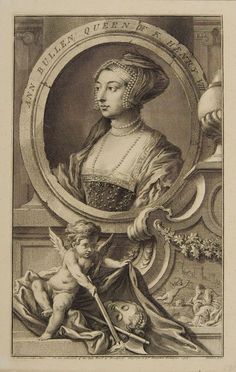
    As to what portrait the miniature may be based from, I suggest possibly this one by Jacobus Houbraken, 1738.


image

    But what makes it intriguing to me is that the Houbraken etching was supposedly done after a Holbein portrait. I’d like to fantasize that the artist was actually looking at the Holbein painting itself when they made this miniature copy, and not this etching! Could we possibly be getting glimpses of the lost full-length Holbein of the queen which was lost in the late 18th century?

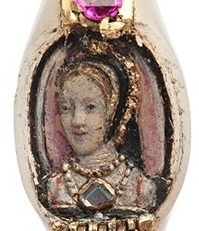
    One last thing... Note the hair of the sitter. It’s the same shade as that seen in Elizabeth’s portrait ring of her mother.


image

    Yes, I’m still an advocate of the Anne Boleyn Was a Redhead school! And it’s interesting the artist would choose to give her hair this shade if they were simply inventing colors for the black-and-white etching above. More fuel for my fantasy that the artist actually saw the lost Holbein! StumbleUpon Share on Tumblr

This is Not Anne Boleyn


This "new portrait of Anne Boleyn" has been making the rounds in social media, and now several news articles

It is not Anne Boleyn.

The picture you see above is a copy of a copy of a copy of a painting that used to be in the collection of Horace Walpole. He was given it by a woman of the court who identified if as Joan, Baroness Bagevenny. Walpole had no reason to doubt this identification, and added it to his collection. The painting was sold in the 1840s, and has apparently vanished from existence. (UPDATE: The painting has not vanished. It still exists and is in a private collection. Art historian Dr Bendor Grosvenor has examined the original painting years ago and searched it for any hint it can be connected to Anne Boleyn . Spoiler alert: He didn't find any.)

Now, a historian has identified it as being Anne Boleyn. But there are serious, serious problems with this identification, which I will break down here. Buckle up, campers, 'cause this is gonna be a long post.

First of all, the earliest sketch of the painting is this one from the Walpole collection. Looks a little different from the one above, even in the facial features.


You'll notice that the "R" insignia on the collar that caused so much excitement is nowhere to be found. That's because the original painting didn't have it, either, as shown in the catalog description of the painting when it went up for sale:


Here is another version of the same sketch.


The "R" insignias are the invention of the third sketch artist. They do not appear in the original sketch, nor in the painting upon which the sketches were based.

Now, on to the details. (I warned you this would be long.)

The style of the hood puts the image firmly in the early 1520s. The lappets in this image almost reach the woman's collarbone. In the 1530s, lappets were chin length (as you can see in Anne's portrait medal.)


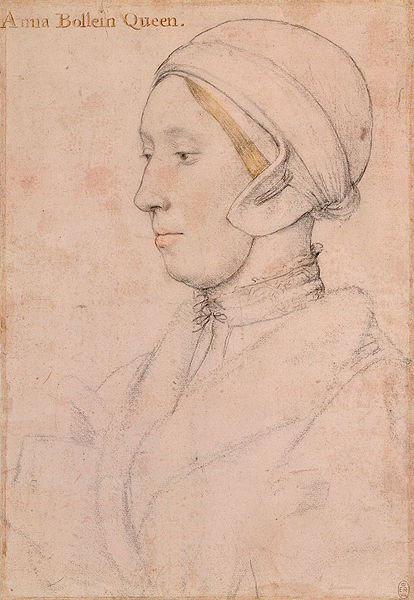
Here is a Holbein sketch from the 1530s said to be Anne Boleyn. Note the lappets.


This is the Anne Boleyn Nidd Hall painting (sometimes said to be Jane Seymour re-purposed.)


Again, note the lappets.

They got shorter every year. By 1536, they were at mouth level.


 It was also fashionable in Anne's time for the veil to be pinned up to the side of the hood, as you can see in the medal. The sitter in the sketch has a veil hanging straight down. (Look at the portrait medal and see how the veil is clumped on the left side of the head. On Jane Seymour's sketch above, it's clumped on the right side.)

The gown itself dates more to the 1520s, as well. The neckline is square and not as low as the necklines in the 1530s. Compare the upper image to the images of  Jane and the Annes. The necklines in the 1530s had gone wider, making them more rectangular and revealing more of the shoulders. You can see a similar neckline in Mary Tudor's childhood portrait.


Anne Boleyn was known to be at the height of style and an innovator in fashion. She would not have worn something so out of date as queen.

Anne Boleyn was not rich enough in the early 1520s to afford the jewels the sitter wears, nor would she have been able to wear them due to the sumptuary laws. In the Hever/NPG portraits, Anne is wearing jewels more appropriate to her station.

Anne was either thirteen years old or twenty years old in 1520 (depending on the birth date you believe.) The sitter in the sketch is clearly a middle-aged woman, not a young girl.

Even the description of the painting says the sitter is a middle-aged woman.

The hood has the letter "I" and "A" repeated. The "I" initials are larger than the "A"s. This lady's given name started with an "I" or a "J." "A" was a secondary name, given less importance.

There is no way to explain the "I" insignias in the context of Anne Boleyn. 


Anne favored the HA cipher after her marriage. She and Henry put it on everything from her personal jewels to the buildings erected during her reign. If it wasn't "HA" it was "AR" or "ARS" for Anna Regina Sovereign. It's inexplicable for her to revert back to a simple "A" with no mention of her marriage or royal status - via crown jewels or other symbols - anywhere in the image. The sitter in the sketch is not royal. She's obviously rich and titled, but she has no indications of royalty whatsoever.


In twenty years of studying Tudor England, I have never heard of the carnation standing for "coronation" as Weir claims in the article. The carnation was a symbol of betrothal or marriage. (And Anne Boleyn certainly would not have had her coronation image painted wearing a headdress and gown almost thirteen years out of style.)

If this really was a coronation portrait, Anne would have worn some of the crown jewels, such as the “consort’s necklace” all of Henry’s queens after Anne are painted wearing.


She would have had “HA” in her headdress instead of just her maiden name. She could have been painted with the crown of St. Edward beside her as her daughter, Elizabeth, did.  She would have used the RAS (Regina Anna Soverign) insignia designed for her, or SOME reference to her royalty, not just her maiden name.


In the Nidd Hall painting, she's wearing the Consort's Necklace, plus three strands of pearls Jane Seymour is later seen wearing in the Dynasty portrait (obviously a royal set.) She also may be wearing the Consort's Necklace with a cross pendant in her portrait medallion... It's hard to tell.


But note the initials Anne chose as queen: AR. She signified her royalty in her post-marriage portraits.

Walpole had good reason to identify the painting with the Bergavenny family. Joan FitzAlan (the reported sitter) was the daughter of the Earl of Arundel (accounting for the "A"). She married the Baron of Bergavenny (the "B".) Her first name accounts for the "I" insiginas. The purpose of this image, whether or not it was painted after Joan's death, was to celebrate the uniting of those houses, Arundel and Bergavenny, and the woman who made it happen - Joan - by dint of her marriage. The design of the image itself screams its purpose.

Though Joan was deceased at the time this image was painted, but posthumous paintings were often done with the current fashions (see the painting of Mary Tudor with Charles Brandon for an example.)

I cannot say for certain the identification is correct and the sketch is Joan. But I'm willing to bet the farm it's not Anne Boleyn.


Read Dr. Bendor Grosvenor's blog article here.
Claire Ridgeway of the Anne Boleyn Files gives her opinion (and was kind enough to link my article!) StumbleUpon Share on Tumblr

The Real Face of Anne Boleyn?

The "Moost Happi" medal is the sole surviving contemporary portrait of Anne Boleyn that we know of. It's badly damaged, so it's a source of frustration for people who want to know the true appearance of Anne Boleyn.


The most commonly recognized portraits of Anne - the National Gallery portrait and the Hever Castle portrait - were created during the reign of her daughter, and may have been intentionally designed to look like Elizabeth. They may bear very little resemblance to the real Anne Boleyn.


Another portrait - a sketch by Holbein - is labeled as being Anne Boleyn (and is accepted as being an authentic portrait of her by the Royal Collection) but many people insist it can't be Anne because the heavy jawline, double chin, and light auburn hair do not match the more "accepted" version of her appearance. Go to this website to see a side-by-side comparison of the two Holbein sketches labeled as Anne Boleyn.


Elizabeth seems to have accepted something close to the Holbein portrait as an authentic likeness of her mother, if her portrait ring is to be believed.


But now, we may be closer to the true face of Anne Boleyn. Using facial-recognition software, Amit Roy-Chowdhury of the University of California, Riverside, has matched the portrait medal to an extant painting of Anne Boleyn. And the closest match to the medal is a portrait that has been long-dismissed as being a true likeness: the Nidd Hall portrait. Research on the subject is not complete, but the association is very interesting.

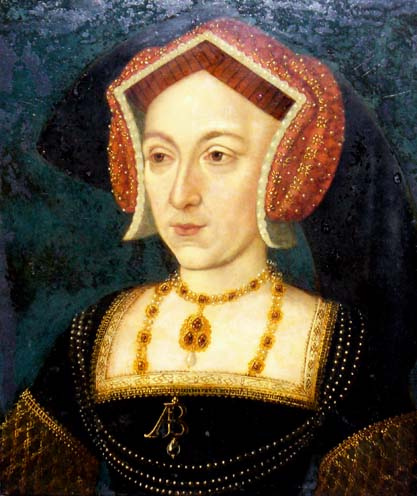
The Nidd Hall portrait isn't flattering. The sitter wears an English-style gable hood, and is identified as Anne by the AB brooch pinned to her gown. But the face with its long nose and receding chin is so different from our "accepted" image of Anne that for a long while, experts have suggested that it was a portrait of Jane Seymour re-touched during the reign of Elizabeth to turn it into a portrait of Anne.

This link has a superimposed slider which allows you to compare the image to the portrait medal.

Some of the jewelry the sitter wears shows up in portrait of Henry's other queens.

Jane Seymour wears the ropes of pearls across her bodice, and Kateryn Parr wears the tri-stone pendant.

The Nidd Hall sitter may also be wearing the "consort's necklace" all of Henry's queens after Anne were painted wearing.

Like the National Portrait Gallery version and the Hever Castle portrait, the Nidd Hall painting was created at least fifty years after Anne Boleyn's death. Unlike the prior two examples, the Nidd Hall portrait was obviously based off of a different "pattern."

The NPG and Hever portraits are supposed to be based off of the same painting ("B" necklace pattern) as the Hoskins miniature. Some suspect the original was a lost Holbein, or the portrait which belonged at one point to Lord Lumley.

It's possible that the positive identification of the Holbein sketch, Lucy Churchill's reconstruction of the portrait medal, and the identification of the Nidd Hall portrait have brought us closer to the true face of Anne Boleyn.

StumbleUpon Share on Tumblr
Erasing Anne Boleyn From History: The Portraits

After Anne Boleyn's execution, her remains were hastily buried in the chapel of St. Peter ad Vincula with no stone to mark the spot where they rested. After she was dead, Henry set about the task of erasing his wife from history. He was rather proficient at it.

It appears most of Anne's portraits were destroyed. The only contemporary portraits that survive are a badly-damaged lead portrait medal, the sketch made for her coronation feast, and - possibly - a Holbein sketch. The other images we have of her were painted in her daughter's lifetime.

Anne's renown and the amount of curiosity this lady inspired meant there once had to be many portraits of her. (Consider the number of portraits created during the short reign of Kateryn Parr.) It is almost a certainty that Anne sat for several portraits. We have no record of a Holbein painting, but it's highly possible one was done, considering Henry's preference for this artist. There may have also been miniatures.

Once a painting of a monarch was created, artists were frequently commissioned to make copies for families to display in their own homes. In those days, prominently displaying a portrait of the monarch was a popular way of demonstrating allegiance, and portraits were also frequently given as gifts from monarchs to favored courtiers and diplomats.

The famous "B" pattern portrait likely is based from a image of a younger Anne, painted before she was queen, during the time when Henry was perusing her as a love interest. After she was queen, Anne would have worn finer jewels that she's pictured in that image; in her portrait medal, she may be wearing the "consort's necklace" (she also wears it in the Nidd Hall painting.) Charles I had a painting of Anne Boleyn copied in miniature by John Hopkins the Elder. It was noted in a 1625 inventory of the king's art as "don by Hoskins after an oweld pictur." It may have been the original image on which the "B" pattern portraits (The NPG/and Hever versions) are based.

So, what happened to Anne's portraits? After her fall, most people probably destroyed them. Courtiers would not have wanted to have the image of a traitor displayed in their home for fear of angering the king. But a few may have survived the purge. Some may remain hidden away to this day.

One full-length portrait of Anne Boleyn supposedly survived in the collection of Baron Lumley, an art lover who collected portraits, especially those of Holbein. It appears after Anne's fall, Lord Lumley chose to put the portrait in storage instead of destroying it. If Anne's portrait was painted by Holbein, that may be the reason Lumley decided to preserve it.

In the 1590s, Lord Lumley had a dispute with Queen Elizabeth over a debt, and all of his property was inventoried. The painting was one of the items that was noted in the inventory. (Of the over 200 portraits in Lumley's collection, only 30 can be identified as extant today.)


The Lumley portrait was known to have survived until the latter part of the 1700s, but after that, it vanished without a trace. It was presumably sold off from the collection, as the other pieces were, but who bought it, and what did they do with it?

It's also possible that portraits still exist but are not identified or are mislabeled. Our "image" of Anne may not match the reality of her appearance, and so we may already have portraits of her we simply do not recognize.

A sketch by Holbein of a woman labelled as Anne Boleyn still exists and is definitively identified in the Royal Collection as being Anne, but people insist it cannot be her because the light reddish hair and double chin which do not match how we picture Anne.

Perhaps the Holbein portrait is still out there somewhere, waiting to be rediscovered. One can hope.


StumbleUpon Share on Tumblr

Mary Boleyn

The birth dates of the three surviving Boleyn siblings are in question, as is the order of their birth. Mary is thought by many scholars to be the eldest because if Anne had been the oldest daughter, it should have been mentioned in the patents creating her Marquess of Pembroke. Mary was also married first, as was traditional for the elder sister. Lastly, Mary’s grandson claimed a title through descent from her, which would only be possible if she were the elder sister. If Anne had been elder, the title would have belonged to Queen Elizabeth, and she would have rejected his claim.

Mary was likely born around 1500 at Blickling Hall to Thomas Boleyn and his wife, Elizabeth Howard. Elizabeth had a child every year, but only three of them survived to adulthood. They moved with the family to Hever Castle sometime during Mary's childhood.

Legend has it Mary was thought to be the more traditionally beautiful of the two Boleyn sisters, but we don't have an authenticated portrait of her, or even a written description. There are several portraits which are said to be Mary, but each has issues which make the attribution questionable

Mary was sent to the French court in 1514 when Princess Mary Tudor (Mary Brandon) married the king of France, and she remained in France after the elderly king died and the princess returned home.

Though it's not certain, Mary may have been a short-term mistress of King Francis at some point during her five years in the French court. Some historians question it, speculating that Mary's reputation may have been slandered in order to cast shame on her sister, Anne. A letter from the Bishop of Faenza in 1536 is the only contemporary record of it.

"[T]hat woman" [Anne Boleyn] pretended to have miscarried of a son, not being really with child, and, to keep up the deceit, would allow no one to attend on her but her sister, whom the French king knew here in France "per una grandissima ribalda et infame sopre tutte." [A great whore, infamous above all]

However, there are some obvious problems with this letter. Mary had been banished from court in 1534 and was not with Anne during her final miscarriage. Chapuys claims to have spoken with people who examined the fetus and said it was a normal male of about four months gestation, so Anne's pregnancy was likely not feigned. The Bishop's veracity in repeating Francis's supposed remark must be viewed with a healthy amount of skepticism.

Beyond that, all we have are later historians, starting with Nicholas Sander in Elizabeth's reign, whose Rise and Growth of the Anglican Schism gave us the claim that Francis called Anne (not Mary, though his words were soon assigned to describe her) his "English Mare" or "royal mule."

Herbert repeats the claim as well, quoting William Rastal's version for good measure.


This author, though learned, yet more credulous than becomes a man of exact judgment, reports out of one William Rastal, a judge, (in his life of Sir Thomas More) that Mistress Anne Bolen was the king’s daughter, by the wife of Sir Thomas Bolen, while, sub specie minoris, he was employ’d by the king, ambassador in France ; and that this gentlewoman coming to the age of fifteen, was def-lour’d by some domesticks of her father’s, and then sent to France ; where also she behav’d herself so licentiously, that she was vulgarly call’d the hackney of England, till being adopted to that king’s familiarity, she was termed his mule.

Later authors repeated the slander, applying it to Mary, not Anne, and it appeared so many times in biographies and books about the period that it became accepted as fact.

If Mary was, indeed, the mistress of Francis, she may have felt she could not refuse the king without repercussions on her family. She may have been in the same situation her sister later faced when Henry was interested in her - as long as the king was pursuing her, no man would offer for her hand and risk offending him. So, she may have felt it best to give into the king's interest in hopes she might be made his official mistress, or he might find her a suitable husband afterward. Francis did neither.

Upon her return to the English court, Mary Boleyn became the mistress of Henry VIII. This can be stated with a reasonable amount of certainty because Henry asked the pope for a dispensation to marry a woman whose sister he had slept with when he was seeking to wed Anne Boleyn. Later, when he was asked if he had slept with both Mary Boleyn and her mother, Elizabeth Howard Boleyn, Henry quickly replied, "Never with the mother."

He was also chastised by Reginald Pole for his hypocrisy in saying his marriage to Katharine was invalid because she had been intimate with his brother when Henry had been intimate with Anne's sister. So, it appears the affair was well-known at the time, and documented by contemporary sources.

We don't know when the affair began. It seems to have around 1519, after his affair with Bessie Blount ended. English kings didn't have "official mistresses" who had political power, and so chroniclers of the day tended to ignore the women who came and went in monarchs' lives.

This affair seems to have been very brief. Mary was married to William Carey in 1520. Carey was a well-connected young man. He was a cousin of Henry VIII and of Henry Percy, who may have been Anne Boleyn's first love.

 Debate continues as to whether this marriage marked the end of Mary's affair with the king.
She had two children during her marriage with Carey, Catherine and Henry. Some have claimed that one, if not both, of those children were fathered by king Henry, but it seems likely if they had been his issue, he would have seized upon this evidence of his virility, as he had done with his son by Bessie Blount. It seems more likely - to me at least - that Mary and the king's brief liaison ended when she wed Carey. But the rumors that Henry had fathered her children began very quickly.

A court case in 1535 contained the following statement:

"Moreover, Mr. Skydmore dyd show to me yongge Master Care, saying that he was our suffren Lord the Kynge's son by our suffren Lady the Qwyen's syster, whom the Qwyen's grace myght not suffer to be yn the Cowrte."

Mary was widowed in 1528. Her husband died during an epidemic of that mysterious illness, "the sweat." Anne became ill from it as well, but survived.

Carey's death left Mary in a precarious financial situation. Her father, Thomas Boleyn, seems to have initially refused to support her. Author M.L. Bruce claims Thomas and Elizabeth disliked Mary because of the bad reputation she had acquired and shame she brought on their family. Whatever the reason, it soon became enough of an issue that the king himself intervened to help sort it out. In one of his letters to Anne, Henry wrote about the situation:

As touching your sister’s matter, I have caused Walter Welze to write to my lord [Thomas Boleyn] my mind therein, whereby I trust that Eve shall not have power to deceive Adam; for surely, whatsoever is said, it cannot so stand with his honour but that he must needs take her, his natural daughter, now in her extreme necessity.

To ease the situation, Mary's son Henry became Anne Boleyn's ward, which meant Anne was responsible for his upkeep and seeing to his education as a gentleman. Anne put Henry into a monastic school, and arranged a pension for Mary of £100 per year.

The records are silent about Mary's life for the next few years. We don't know where she lived, but some believe she returned to stay at Hever Castle. Her family would have been at court with Anne, her mother as chaperone and her father trying to champion the king's annulment from Katharine of Aragon. The only mention of her is in 1530, when Anne was given £20 to buy a jewel from Mary. Had it been a gift from Henry at some point, or as one scholar theorized, had Anne pawned it to her? The latter seems odd, since Anne had greater access to funds than Mary did.

In 1532, Mary traveled with Anne on her trip to France with the king to be presented as his consort, so she may have been back at court already as one of Anne's attendants. At the masquerade where Anne not-so-subtly met with Francis, Mary was given the position of honor, walking directly behind the new queen-to-be. If Mary really was Francis's mistress at one point, it's tempting to speculate about what their reunion meeting must have been like.

Does Mary's position of honor indicate the sisters were also emotionally close? Many have portrayed Mary and Anne as being jealous of one another, but we have no evidence one way or the other. Mary had another position of honor when her sister was coronated the following year, and she remained at court as a lady in waiting to the new queen.

In 1534, Mary secretly wed William Stafford. Stafford wasn't a suitable match for her. Mary was in her mid-thirties at this time, and Stafford was about twelve years younger than she. He was a soldier, the second son of a Essex landowner, and a commoner to boot. Stafford was stationed at Calais in 1533, and perhaps that's where his romance with Mary Boleyn began.

Mary managed to keep the marriage a secret until she became pregnant. When the Boleyns found out, they were horrified and furious. Mary was sister of the queen; her marriage was a matter of state interest. For her to arrange her own match for personal preference instead of family benefit was both disobedient to the social order and disrespectful of her sister's position. It made the family look ill-behaved.

Mary and Stafford were banished from court. We don't know where she lived during this time. What is known is that Mary's financial situation became so dire, she was reduced to begging the queen for help.

Unable to write directly to Anne, Mary wrote an eloquent letter to Cromwell about the situation. She asked him to speak to Henry or Anne on her behalf, 


Master secretary, after my poor recommendations, which are little to be regarded of me that am a poor banished creature, this shall be to desire you to be good to my poor husband and to me. I am sure it is not unknown to you the high displeasure that both he and I have both of the king's highness and the queen's grace, by the reason of our marriage without their knowledge, wherein we both do yield ourselves faulty, and do acknowledge that we did not well to be so hasty or so bold without their knowledge.
But one thing, good master secretary, consider that he was young, and love overcame reason; and for my part, I saw so much honesty in him that I loved him as well as he did me, and was in bondage, and glad I was to be at liberty: so that for my part, 1 saw that all the world did set so little by me, and he so much, that I thought I could take no better way but to take him and to forsake all other ways, and live a poor honest life with him; and so I do put no doubts but we should, if we might once be so happy to recover the king's gracious favour and the queen's.
For well I might have had a greater man of birth, and a higher; but I assure you I could never have had one that should have loved me so well, nor a more honest man. And besides that, he is both come of an ancient stock, and again as meet (if it was his grace's
pleasure) to do the king service as any young gentleman in his court.
Therefore, good master secretary, this shall be my suit to you, that for the love that well I know you do bear to all my blood, though for my part I have not deserved it but little, by the reason of my vile conditions, as to put my husband to the king's grace, that he may do his duty as all other gentlemen do. 
And, good master secretary, sue for us to the king's highness, and beseech his highness, which ever was wont to take pity, to have pity on us: and that it would please his grace of his goodness, to speak to the queen's grace for us; for as far as I can perceive, her grace is so highly displeased with us both, that without the king be so good lord to us as to withdraw his rigour and sue for us, we are never like to recover her grace's favour, which is too heavy to bear.
And seeing there is no remedy, for God's sake help us, for we have been now a quarter of a year married, I thank God, and too late now to call that again: wherefore there is the more need to help. But if I were at my liberty and might choose, I assure you, master secretary, for my little time, I have tried so much honesty to be in him, that I would rather beg my bread with him than to be the greatest queen christened; and I believe verily he is in the same case with me, for I believe verily he would not forsake me to be a king; therefore, good master secretary, being we are so well-together, and do intend to live so honest a life, though it be but poor, shew part of your goodness to us, as well as you do to all the world besides; for I promise you ye have the name to help all them that have need; and amongst all your suitors, I dare be bold to say that you have no matter more to be pitied than ours; and therefore for God's sake be good to us, for in you is all our trust; and I beseech you, good master secretary, pray my lord my father, and my lady, to be good to us, and to let me have their blessings, and my husband their good will, and I will never desire more of them.
Also I pray you desire my lord of Norfolk, and my lord my brother [George Boleyn] to be good to us; I dare not write to them, they are so cruel against us; but if with any pain that I could take with my life I might win their good wills, I promise you there is no child living would venture more than I; and so I pray you to report by me, and you shall find my writing true; and in all points which I may please them in, I shall be ready to obey them nearest my husband, whom I am most bound to, to whom I most heartily beseech you to be good unto, which for my sake is a poor banished man, for an honest and a godly cause; and being that I have read in old books that some for as just causes have by kings and queens been pardoned by the suit of good folks, I trust it shall be our chance, through your good help, to come to the same, as knoweth the God who sendeth you health and heart's ease.
Scribbled with her ill hand, who is your poor humble suitor always to command.

If Cromwell replied to this letter, it is not recorded. The records are also silent as to whether Mary's uncle, the Duke of Norfolk, or her brother George relented in their anger toward her, but Anne is said to have sent Mary a gold cup and some much-needed funds, though she did not give Mary permission to return to court. She couldn't, as much as she may have wanted to. Mary had defied the social order and that was something Anne could not publicly forgive without causing severe damage to her own reputation.

Sadly, Mary seemed to have either lost the child she was carrying, or it died shortly after birth. Various sources record that she had a child named Anne or Edward, but there is no solid record of Mary having any issue with William Stafford. Her descendants today originate from her children with William Carey.

It’s thought Mary and Anne never saw one another again after Mary was sent from court. It wasn't long afterward that Mary's brother and sister went to the scaffold. There is no record of Mary attempting to contact George or Anne in prison. That's not certain evidence she didn't, of course. Perhaps she knew there was nothing she could do.

There is no record she ever made contact with Anne's daughter, Elizabeth, after her execution. One movie has Mary Boleyn striding away with baby Elizabeth under her arm to care for her after her mother's death, but that's entirely fictional.  Elizabeth's accounts note no gifts from Mary or visits. Elizabeth's household was carefully monitored by the king and any contact with Mary would have been noted.

In March 1539, when her father died, Mary inherited the Boleyn estate, which allowed her to fund her children Henry and Catherine's careers at court. Her daughter Catherine served in the households of Anna von Kleefes and Elizabeth I, and made a fine marriage to Francis Knollys. In 1542, Mary inherited the property of her executed sister-in-law, Jane Parker. But legal wrangling over the property lasted until 1543, and she and her husband acquired Rochford Hall only a few days before Mary died.

Most of Mary's property was inherited by her son, Henry, but she did leave some manors to William Stafford. The location of her grave is unknown. She may have been buried at St. Andrews at Rochford, but the church records do not go back that far and no trace survives of her tomb. It's possible the tomb may have been destroyed in the Reformation.
StumbleUpon Share on Tumblr