Showing posts with label Children. Show all posts

Did Henry VIII Father Mary Boleyn's Children?


On March 4, 1526 Henry Carey was born. He was the second child of Mary Boleyn, who'd had a daughter, Catherine, in 1524. For five hundred years, rumors have abounded that one or both of these children were fathered by Henry VIII.

Mary likely became the mistress of King Henry around 1519, after his affair with Bessie Blount ended. She married William Carey in February, 1520 and it's assumed by some that her marriage marked the end of her affair with Henry. Mary had her first child four years later, and another child two years after that.

The alternative theory has Mary and Carey in a long-term, sexless marriage of convenience to cover Henry's illicit relationship with her. She doesn't conceive until five years into her relationship with the king, and then gives him a son two years later. In this scenario, the end of Henry's relationship with Mary coincides with the first recorded declaration of the king's interest her sister, Anne Boleyn.

Is there any evidence Henry's involvement with Mary continued after 1520 and her marriage to William Carey?

The chief evidence seems to rest on a series of grants that Henry made to William Carey between 1522 and 1526, which some argue were akin to payments for the "use" of Carey's wife.

Genealogy Magazine notes:
Mary Boleyn’s affair with the King probably commenced at about the same time: 1522. "The spate of royal grants to her [Mary Boleyn’s] husband [William Carey] in 1522, 1523, 1524 and 1525 is also suggestive." "[T]he first manors and estates, as opposed to minor keeperships and stewardships, that Mary’s husband possessed were granted to him by the crown in June 1524 and February 1526." It should be especially noted that the February 1526 grant occurred on the 20th, just twelve days before the recorded birth of Henry Carey on 4 March 1525/6. Significantly, this royal grant included the borough of Buckingham which was granted to William Carey "in tail male." It is impossible not to be struck by the coincidence of this entailment to a male "heir," just twelve days before the date of record on which William Carey’s wife gave birth to a male child said to be the king’s son.

I find no significance in the grant being "in tail male." That was a normal part of the wording of grants of the era. Secondly, there's no way Henry could have known the upcoming baby was a boy, so there's no "coincidence." Why wouldn't the king have for the birth itself if it was a celebration of his child, or waited to see if the baby turned out to be a boy if the intent was to give a grant to his son? Considering the high infant mortality of the day, and the equally high possibility the child could have been a girl or a stillbirth, it's likely the grant had nothing to do with Mary's current pregnancy.

If Henry wanted to hide his relationship with Mary, why "pay" her husband openly in the form of grants, which were recorded for posterity? Why wouldn't Henry just secretly slide some cash across the table to Carey?

There is no reason to assume that the grants were on Mary Boleyn's behalf. William Carey was Henry's second cousin, and a highly favored member of his court. He received grants in roughly the same pattern and amount as others of Henry's favorites - there was nothing unusual about this stream of gifts from the king's hands, so it did not have to be in "payment" of anything.

Another point I've seen mentioned is the dispensation Henry requested to marry Anne Boleyn. He asked in it to be freed of any impediments arising from both illicit intercourse and consanguinity, which people say wouldn't have been necessary without children from the relationship. This is incorrect. Firstly, Henry was trying to be as vague as possible in the dispensation because he didn't want to openly name Anne as the woman he was seeking to marry, and so he phrased the wording as widely as possible to cover a lot of different scenarios. Secondly, Anne and Henry were related, and so the dispensation was needed to absolve them of the blood relation of their common descent. Henry also needed a dispensation to clear himself of the illicit intercourse with her sister, whether or not there had been any children from the union.

The other "evidence" for the Carey children being Henry's comes from snippets of recorded gossip. An ambassador mentioned a promising "natural son" of Henry's in 1531, who was the son of a widow of one of his peers. But this could easily refer to Henry FitzRoy, since Bessie Blount had been widowed the previous year.

A court case in 1535 contained the following statement:

"Moreover, Mr. Skydmore dyd show to me yongge Master Care, saying that he was our suffren Lord the Kynge's son by our suffren Lady the Qwyen's syster, whom the Qwyen's grace myght not suffer to be yn the Cowrte."

However, Mary had been welcome at Anne's court and given positions of honor until she secretly re-married in 1534 and was banished because of her violation of the social order. So Anne's supposed banishment of Mary out of being unable to bear her jealousy does not seem to ring true. Secondly, Hale was confessing to slanderous talk about the king for which he was in a lot of trouble. He says he was ill and doesn't remember half of what he said.

I had several falls from my horse, from one of which I was troubled in my wits, as also by age and lack of memory.

It shows only that there was current gossip about the king's relationship with the queen's sister, nothing more. The same standard could be used to "prove" that Henry had an affair with Elizabeth Howard.
Don't see it myself, personally

The last bit of evidence centers on a supposed resemblance Henry Carey had to the king. But this, too, is easily explicable. Henry and William Carey were both descendants of the Beauforts. (William Carey's grandmother was the niece of Margaret Beaufort's father.) The Carey children had red hair, but red hair ran in the Howard family (Elizabeth Howard was Mary and Anne Boleyn's mother.) Katheryn Howard had red hair, Anne Boleyn herself may have been a redhead, and we don't know what color Mary Boleyn's hair was.

In my opinion, there isn't any conclusive evidence that Mary Boleyn's children were Henry's, and the evidence they weren't is actually stronger.

Finding Mary a husband seems to have marked the end of Henry's involvement with her, as it did with Bessie Blount. There's no evidence his involvement with either woman extended after her marriage. The king was the one who decided when these women would marry - their families would not risk angering him by arranging a marriage to another man while the king was still interested in their daughter. There was no reason for the king to marry off either woman before he was "done" with her, either. He had no embarrassment in claiming Bessie Blount's bastard as his own, or he would have hurriedly tried to marry her to someone else as soon as he found out she was pregnant. Instead, he waited until after the child had been born and their affair was over.

When Mary Boleyn was widowed in 1528, the king showed little or no interest in the fate of her children until Anne Boleyn interceded and urged the king to get her father to support Mary. Author M.L. Bruce believes the Boleyn family disliked Mary because of her immoral behavior with Henry (and possibly King Francis before him.) Henry wrote to Anne, who was still recovering from the same epidemic of the Sweat that had killed her brother-in-law, and assured her that he had contacted Thomas Boleyn.

One of his statements in the letter is especially poignant, given the situation:

... for surely, whatsoever is said, it cannot so stand with his honour but that he must needs take her, his natural daughter, now in her extreme necessity.

His own "natural daughter" and "natural son" would have been in extremity, too, because of Mary's poverty if they were Henry's children. Henry was later guilty of gross, extreme hypocrisies, but it's hard to imagine that Anne wouldn't have pointed out his own honor compelled him to support the children if they were his.

The Boleyn family eventually settled a pension on Mary of £100 per year, and Mary's son, Henry Carey, became Anne's ward. She would see to his education and upkeep as a man of gentle blood, reducing Mary's financial burdens. Some have painted this in the light of Anne acquiring an "heir" for Henry if she wasn't able to provide him with her own son, but this is illogical. Wardship was simply a financial guardianship. Plenty of people actually married their wards, such as Charles Brandon marrying Catherine Willoughby, so making the boy her ward did not make him Anne's son any more than Catherine Willoughby was Brandon's daughter. Secondly, Henry Carey would still be an unacknowledged bastard, worse off than Henry FitzRoy, who at least was acknowledged by his father - it didn't matter that Anne was the sister of his mother, or that he was her ward.

One wonders what Mary Boleyn would have thought if the king wouldn't even publicly acknowledge her children, while giving his son with Bessie Blount two dukedoms in 1525, then leaving her in poverty when her husband died three years later. This disparity in the treatment of his supposed children is problematic when there's no real reason for it. I've seen explanations that he didn't really "need" a second illegitimate son, but this was at a time in his life when Henry had begun proceedings to rid himself of his wife based on the fact he couldn't have children with her.

Henry VIII was sensitive about the perception of his fertility. As soon as Bessie Blount gave him a son, Henry publicly claimed the boy and ennobled him - something no king had done for hundreds of years. Why would he not have claimed Mary Boleyn's children, as well, even if he didn't go to the extra step of ennobling Henry Carey? It seems odd that he would not even have mentioned fathering a son with Mary Boleyn when he was busy pointing out his marriage with his queen was "cursed" by God with infertility but he could easily father male children with other women.

Another bit of evidence lies in Reginald Pole's chiding letter to Henry about the hypocrisy of annulling his marriage to Katharine of Aragon in order to marry Anne when his relationship with Mary created the exact same kind of incestual relationship.

 [Anne] had learned, I think, if from nothing else, at least from the example of her own sister, how soon you got tired of your mistresses; and she resolved to surpass her sister in retaining you as her lover . . . 

Pole's letter says nothing about Henry having children with Mary, and he mentions Henry growing quickly tired of his mistress. A relationship of six years (the high end of the estimate of how long Henry's affair with Mary lasted, giving him time to father both children) doesn't really fit with Pole's description of Henry quickly tiring of a lover.

Henry never attempted to find fine marriages for Mary Boleyn's children, which one would think would be the least he could do if they were his. The two Carey children married well, but the king didn't provide Catherine with a fine dowry, or intercede to find Henry Carey a better bride than a simple country gentlewoman.

In short, Henry never behaved as an interested father toward these children, taking interest in their education or in seeing them set up with good marriages. They were on their own, as far as he was concerned. Mary Boleyn was able to fund their careers at court once she received her inheritance from the Boleyn family, and they did well, but it doesn't seem the king did them any special favors. It wasn't until the reign of Queen Elizabeth, who favored her Boleyn relatives, that Henry Carey was ennobled, being created a baron and Catherine was given important positions at court.

Henry was hypocritical at points and a sociopathic jerk, but he was proud of the children he had and saw them as extensions of himself. I doubt he would have utterly abandoned his children with Mary Boleyn. StumbleUpon Share on Tumblr

The Other Boleyn Boys

Anne, Mary, and George Boleyn are the famous Boleyn siblings, but there were at least two other Boleyn children who are known to us only by their graves, and a few faint historical traces that leave more questions than they answer.

Around 1498, Thomas Boleyn married Lady Elizabeth Howard, though we're unsure of the exact date. Later in life, Thomas wrote:

When I married I had only 50£ a year to live on for me and my wife as long as my father lived, and yet she brought me every year a child.

Thomas Boleyn could have been exaggerating slightly - or some of these pregnancies might not have resulted in living children - but it seems most of Elizabeth's pregnancies occurred early in their marriage, in rapid succession. We know of at least five Boleyn children.

The stories of Mary, Anne and George are well-known ... But what happened to the other Boleyns?

In Saint John the Baptist Church of Penshurst, there's a small brass cross set into the floor over the small tomb slab of "Thomas Bwllayen the sone of Sir Thomas Bwllayen." It's in the Sidney chapel, tucked against another monument, a tiny marker on the floor that's easy to miss.

In St. Peter's Church, Hever, there is the little tomb slab of Henry Boleyn, marked in the same fashion, with a slightly different cross. This grave is set into the floor beside the head of Sir Thomas Boleyn's chest tomb.

Both tomb slabs are very small - only a couple of feet square, and the simple brasses that mark them are stylistically dated to around 1520. Because stillborn children weren't usually named or memorialized, these boys likely lived for at least a short time.

Thomas the Younger - as I'll call him to avoid confusion with his father - might have been the eldest son, based on common naming traditions of the day, but that is not a certainty. Henry's place in the birth order of the Boleyn children is unknown, open to speculation.

What happened to these "other Boleyn boys?" Based on the size of their graves and the simplicity of their markers, most historians have come to the conclusion that both of them died as infants. However, it's recently been suggested by Alison Weir in her biography of Mary Boleyn that both Thomas the Younger and Henry lived to adulthood.

In the first edition of this book, I stated that Mary's brother, Thomas Boleyn, was buried in Penshurst Church, and that his tomb is marked by a brass cross and the date 1520. 
[...]
The inscription on the brass reads 'Thomas Boleyn, son of Sir Thomas Boleyn'. That must date the brass to after June 1509, when the elder Thomas was knighted. Brasses were often small, even for adults, so the size of this brass does not necessarily indicate that Thomas Boleyn died in infancy. Indeed, he is likely to have been the eldest son, and if he was the son who went to Oxford University at 17, then he must have been born in the mid-to-late 1490s. After perhaps studying at Oxford, it is possible that he entered the household of the Duke of Buckingham, which might explain his burial at Penshurst. Buckingham, of course, was executed in 1521. 
[....]
It is possible that these brothers both lived into early manhood; it may even have been Henry who went to Oxford. Two cross brasses of similar date might indicate that they died around the same time, possibly from the same cause. In 1517, for example, there was a severe epidemic of the sweating sickness, which caused high mortality in England, notably in Oxford and Cambridge.

The first problem with Weir's theory is the idea that Thomas the Younger was born in the "mid to late 1490s." We know that Elizabeth Howard was unmarried in 1495, based on the poem written about her by John Skelton. Elizabeth's jointure was documented in the summer of 1501, and jointure was usually settled within a year after the marriage, though there was no exact time limit. Scholars typically place the date of Thomas and Elizabeth's marriage in 1498 or 1499, so 1499 seems like the earliest possible birthdate for Thomas the Younger. He wouldn't have been seventeen, and able to attend Oxford, until 1515 or 1516.

Secondly, there is no evidence of Thomas Boleyn the Younger or Henry Boleyn as adults. Neither is mentioned in the records as being a student at Oxford unlike their brother, George - though it is true that not every student who didn't matriculate is noted.

It would be surprising if the ambitious Sir Thomas Boleyn didn't try to get his eldest son a position at court, but Thomas the Younger is not mentioned in the records. We have mentions of Anne and Mary at their respective courts as early as 1514, but no records of Sir Thomas Boleyn negotiating for a fine marriage for his eldest son or attempting to get him a position. The one reference we have, to a "Master Boleyn" attending a court function with his father, may easily refer to George.

Nor are there - as far as I know - any records that show a Thomas Boleyn serving the Duke of Buckingham. The accounts of the duke's household do not mention Thomas Boleyn the Younger (and Buckingham left behind a surprising amount of personal accounts, records, and correspondence.) Thomas the Younger may not have been particularly of note to his contemporaries, but it certainly would have been worthy of mention for later researchers if they discovered his name among the records. 

This is not - of course - absolute proof that Thomas the Younger and Henry were already dead, but there isn't any proof they were alive, let alone attending Oxford, or serving the Duke of Buckingham circa 1520.

More importantly, if Thomas the Younger and Henry died in 1520, why were their grave markers so simple, more suitable to infants than a courtier and heir to a wealthy, influential man? Brasses commemorating adults usually showed a figure in prayer.

Nor does this account for the very small sizes of the tomb slabs themselves, which was usually - though not always - large enough to cover the entire length of the grave. It makes little sense that adult Boleyn men would have been buried so simply, under such tiny monuments, at a time when the Boleyns could afford better.

Applying Ockham's Razor to the situation, the simplest explanation seems the correct one in this case. Is it more likely that the two "other Boleyn boys" lived until 1520 while attending university and a ducal court without being noted in any records of the day, died at roughly the same time, and then were buried in different churches beneath tiny tomb slabs bearing the plain, simple markers of infants? 

Or is it more likely that Thomas and Henry died young and their tombs were marked later when the Boleyn family had more funds?

In the Tudor era, graves of infants were often unmarked. It was a time in which a third of children died before age five, and a full fifty percent would not survive to adulthood. Even the children of royalty might lie in unmarked graves. Henry the Duke of Cornwall, son of Henry VIII and Katharine of Aragon, died before he was a month old and was given a lavish funeral in Westminster Abbey, but his grave was unmarked, though the general location is known. 

When infant burials were marked, the memorials were usually very simple, such as the brass crosses seen on the graves of the Boleyn boys. Another form was known as the "chrysom brass" that showed a swaddled infant.

That the Boleyns had these memorials installed years after the deaths of their babies implies an emotional aspect to the decision. They weren't under any societal expectation to do so, in other words. They must have marked these graves because they wanted Thomas and Henry to be remembered.

Weir is certainly correct that the brasses cannot date from before 1509 when Sir Thomas Boleyn was knighted. If they do, indeed, date from around 1520 (the word "circa" gives a decade of wriggle room on either side of that number) the brasses likely wouldn't be commemorating infants that recently died. At that date, Elizabeth Boleyn would have been in her forties, and probably was no longer having children.

The similarity in the brasses could be put down to the simple fact that they were created around the same time - possibly even by the same workshop - to mark both extant tombs. The cross of Thomas the Younger is more detailed, as would befit a first son, but the inscription plates are nearly identical.

But questions remain. Why was Thomas the Younger buried at Penshurst instead of at Hever with Henry and Sir Thomas Boleyn? 

Claire Ridgway at the Anne Boleyn Files speculates that the Boleyn family was visiting Penshurst while Hever was being renovated after Thomas inherited it in 1505. Perhaps that's where Thomas the Younger was born and passed away shortly after birth. She has an excellent video about the controversy.

People were often buried where they died, even if they were just visiting. Anne Astley, sister of Elizabeth Wood Boleyn, died in childbirth during a visit to her sister's home, and is buried at Blickling Hall. Elizabeth Boleyn herself is buried with her family at Lambeth, where she may have been visiting when she passed away.

Henry, then, may have been born after 1505 when the Boleyns moved to the castle. The family marked his grave in the Hever chapel after 1509 when his father was knighted. Decades later, Sir Thomas Boleyn's tomb was placed right beside that of his infant son.


StumbleUpon Share on Tumblr

Tudor Childhood

"Childhood," as we think of it, is a relatively new concept, invented in the Victorian era. The Victorians began to view childhood as a time of innocence and play - for wealthy children, at least - but this was not how childhood was always viewed in earlier eras. Children, for the most part, were expected to behave like adults. Few allowances were made for their youth when it came to education or making mistakes.

The Tudors saw childhood as a somewhat dangerous time, and not just because 50% of children didn't live to see adulthood. They saw children as being in severe danger of becoming reckless, immoral people, unless very strictly kept to the path of righteousness.

Showing affection, it was said in advice manuals, would spoil a child. Affectionate parents might not discipline as harshly as needed and a child's character would then tend toward evil. The advice manuals suggested a child needed regular corporal punishment to keep them obedient. Obviously, there must have been parents who resisted this notion, because the manuals insist so strongly upon it. They warned that sparing the rod would lead to sedition and evil, perhaps even to patricide.

And if thy children be rebel and will not bow them low,
If any of them misdo, neither curse them nor blow [yell];
But take a smart rod and beat them in a row,
Till they cry mercy and their guilt well know.
Dear child, by this lore
They will love thee ever more

Children were urged to see these beatings as being in their own best interest:


A wise child, lore he behoveth;And as men say that learned be,
Who spareth the rod, the child hateth he;And as the wise man saith in his book,
Of proverbs and wisdoms, who will look:
"As a sharp spur maketh a horse to move,
Under a man that should war prove,
Right so a yard [rod] may make a child,
To learn well his lesson and to be mild."Lo! children, here may ye all hear and see,
How all children chastised should be.
And therefore, childer, look ye do well,
And no hard beating shall you befall.


 Jane Grey once famously complained:

For when I am in the presence either of father or mother, whether I speak, keep silence, sit, stand or go, eat, drink, be merry or sad, be sewing, playing, dancing, or doing anything else, I must do it as it were in such weight, measure and number, even so perfectly as God made the world; or else I am so sharply taunted, so cruelly threatened, yea presently sometimes with pinches, nips and bobs and other ways (which I will not name for the honour I bear them) so without measure misordered that I think myself in hell.


But we have no certain evidence that Jane's parents were especially cruel for the time, other than the scanty recollections passed down to us. It may be that Jane's parents were simply strict, as the advice of the era urged them to be, and would tolerate no indolence from their daughter.

You may have heard of "whipping boys" used in Tudor times. This was actually a less formalized custom than might be suggested by the term. For very highly ranked children, the school master might hesitate to strike them. Instead, they would beat the child's favorite companion/servant, inflicting emotional pain, rather than physical. Charles I had a common-born companion named William Murray who served as his whipping boy. When Charles became king, he made Murray an earl.

Corporal punishment did not end with childhood. Servants and wives were frequently whipped. Cardinal Wolsey is recorded to once have taunted Will Somers with a rhyme: "A rod in school/ and a whip for a fool/ are always in season."

Children were expected to have deep, reverent respect for their parents or face the rod. Noble-born children - raised by an army of wet nurses, "rockers," dry nurses, governesses, and tutors - likely only saw their parents once per day, when they went to seek their parents' blessing before bed. In the evening, children would be presented to their parents to ask for a blessing. They would kneel in front of them, removing their hats. They would sometimes be asked to recite their lessons for the day or a Bible verse, and then the parent would lay their hands on the child's head and bless them. (Traces of this custom remain in parents giving their children a good night kiss.) Even as adults, children were expected to kneel in front of their parents.

And child, worship thy father and thy mother;
Look that thou grieve neither one nor other,
But ever, among them thou shalt kneel down,
And ask their blessing and benison
[benediction].

Note the guinea pig and bird. Children often
held their pets in portraits.
Education began very early, especially for royalty and the nobility. Princess Mary was able to play the virginals well enough to impress Imperial ambassadors at age four, and was able to speak Latin by age nine. At age three, Prince Arthur Tudor had a strict educational schedule which made him proficient in languages and statecraft, and conversant in all of the prominent classical philosophers by age fifteen.

It was customary to send a child away at age seven or eight to continue their education in another family's care, or as in Anne Boleyn's case, to send the child to court to be placed in a noble's household, almost like a finishing school.

The daily schedule for children was very long in comparison to today. The following is the account of a school day schedule from 1612:

Work begins at 6, and those who come first have the best places. At 9 o clock, there is given 15 minutes for breakfast and recreation; then work continues until n[oon] or past (to balance the 15 minutes off). Dinner follows, and then work until 3 or 3:30, then 15 minutes off, and work until 5:30, when school closes with a piece of a chapter, two staves of a psalm and prayer by the master.

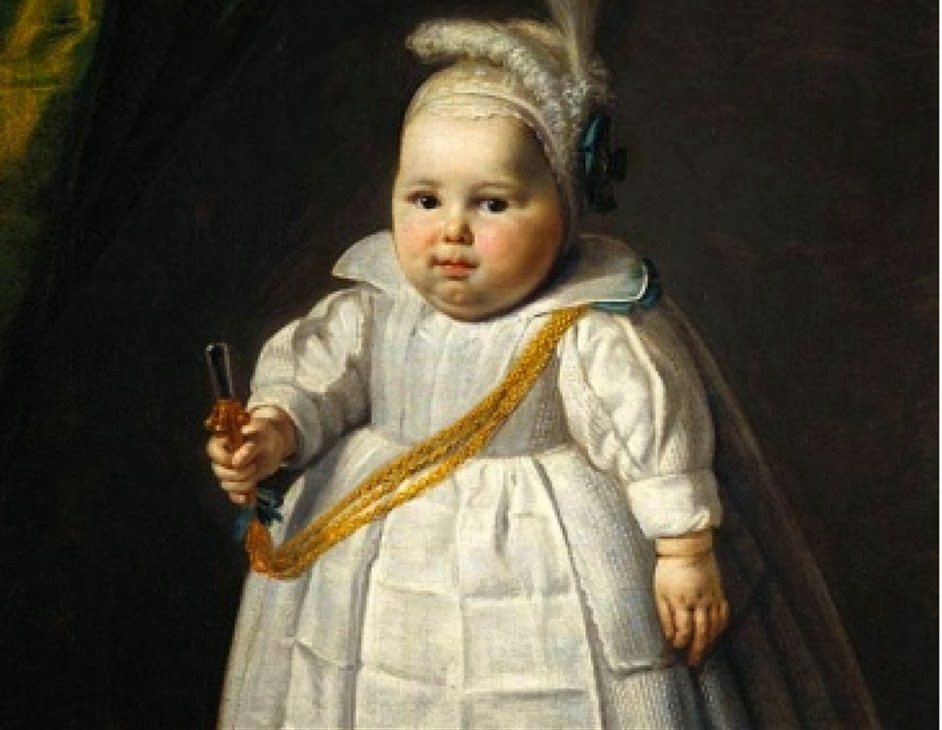
This delightfully plump baby wears
a dress so new that the crease marks
from folding are evident on the front.
Queen Elizabeth I's wards had the following daily schedule:
They went to church at 6 o clock, studied Latin until 11, dined from 11 to 12, had music from 12 to 2, French from 2 to 3, Latin and Greek from 3 to 5, then prayers, supper, and "honest pastimes" until 8, then music until 9, and so to bed.
Princess Elizabeth learned languages with the method of "double translation." She would translate a text, and then a couple of days later, translate it back to English and see how closely it matched the original. It was an activity she apparently enjoyed so much that she did it for fun in her adult years.

The child in the center is likely a boy,
judging by the sword strapped to his hip.
Poor children, of course, worked just like adults when they were physically able to do so. Some common children were able to go to parish schools and such, but only if their parents could spare their labor. Children were allowed to play, but it depended a lot on economic pressures and how closely their parents adhered to the notion espoused by advice manuals: that children should be "sober and sad" and devote their time to work, study and prayer instead of games.

Children were dressed in the same clothing as adults. Until age six or seven, a boy wore dresses modeled on those of his mother.

Some things never change. Commentators of the day suggested parents should not let kids choose their clothes because of children's foolish taste in fashion:


Let not children have their pleasures in the ordering of their garments. Some delight to have them jagged and cut; but such fantasticness ought to be reformed by wiser and elder, considering their foolishness is beyond measure, if all may be done at their pleasure; and ancient writers repute them out of their wits and madmen that favour it. Again, painted and gawdy apparel is not so fantastic in children's eyes ; but as costly to the parents purses, whereby ancient writers proclaim such parents fellow-fools with their children.

Being "breeched" signified the boy's passage into the male sphere of life, rather than a mother's care. The three ages of childhood were based on sevens. The first stage was infancy, the second stage was until age fourteen and was the main educational stage. After fourteen, the child was considered an adult in almost all respects, old enough for marriage.
StumbleUpon Share on Tumblr