 Had Henry VIII's matrimonial turmoils really been about having heirs for England, Anna von Kleefes would have been the perfect choice as a wife. Her grandfather was nicknamed "the babymaker" because he had a whopping sixty-three illegitimate children besides the kids he fathered with his wife. Anna's own father seems to have been more conservative with his progenitive activities, but there was no doubt Anna came from a fertile line, and was young and healthy. She was intelligent, well-mannered and blue-blooded. The perfect Renaissance princess.
But Henry wasn't attracted to Anna, and that was reason enough for him to buck a thousand years of European matrimonial tradition, risk war and upsetting the power balance of continental alliances, and lowering the prestige of his dynasty - and England itself - in the eyes of the world.
 Since their disastrous meeting on New Year's Day, Henry VIII had been desperately searching for a way out of marrying Anna. He tried to find an irregularity in the dispensation that had been issued after her failed betrothal to the Duke of Lorraine, but the Duke had been only ten at the time the marriage was arranged, and canon law held the betrothal was invalid on that basis alone. The envoys from Cleves insisted they had ample proof that the betrothal had been properly canceled. Henry tried demanding written proof. They had copies of the documents; Henry said he wanted to see the original.
The diplomats must have been frustrated and somewhat alarmed. These issues had already been discussed and settled even before the marriage was agreed upon. The diplomats boldly offered themselves as hostages, to act as a bond that the documents did exist and were legitimate. Checkmate.
Anna was being feted at banquets and introduced to the English court as their new queen, all while her intended husband was scrambling to find a way out of his engagement that wouldn't spark an international furor. Henry required that Anna herself appear before notaries and swear she was free of any impediments to their marriage. Was he hoping she would be offended by the request and refuse, causing a delay? If so, he was disappointed. Anna swore as requested.

Henry was resentful, to say the least. He muttered to Cromwell,
If it were not that she is come so far into England, and for fear of making a ruffle in the world, and driving her brother into the Emperor and the French King's hands, I would never have her: but now it is too far gone, wherefore I am sorry.
Their wedding was held at Greenwich. Archbishop Cranmer himself performed the service, and the king gave Anna a wedding ring inscribed with the words GOD SEND ME WEL TO KEPE.
The anxious Cromwell asked the king how his wedding night had gone the next morning, and Henry had a litany of complaints about his new bride.
Surely, my lord, I liked her before not well, but now I like her much worse! She is nothing fair, and have very evil smells about her. I took her to be no maid by reason of the looseness of breasts and other tokens, which, when I felt them, strake me so to the heart, that I had neither will nor courage to prove the rest. I can have none appetite for displeasant airs. I have left her as good a maid as I found her.

Needless to say, Henry was sort of touchy about the impotence thing since the trial of wife #2, when George Boleyn had read out Anne's accusation that Henry was unable to perform with her.
 Poor Anna! Groped a bit by her resentful husband, who then rolled over and fell asleep, and - according to him - had two nocturnal emissions thinking about other women. Anna had to be terrified. She spoke very little English, and her new homeland was a place of strange customs. Her husband - who had already killed one wife and divorced another - obviously disliked her.
Anna was alone. Her ladies from Cleves had been replaced by a contingent of English ladies in waiting, including a winsome young girl named Katheryn Howard, and Jane Parker, the former sister-in-law of Anne Boleyn.
Anna was an intelligent woman. She knew the court was tittering and gossiping about the non-consummation. The king was making a public issue of it, after all. Her mind must have been racing with what this might portend, and she wisely decided to play along.

Cromwell was in a panic. He asked Anna's Lord Chamberlain, the Earl of Rutland, to talk to his wife and see if she could get Anna to take the initiative in getting the king to consummate the marriage. The countess supposedly urged Anna to be more "pleasant" to the king when he came to her chamber in the evenings. Whatever Anna replied to that led Jane Parker to say to the queen that she believed Anna was still a maiden.
Anna replied,
How can I be a maid... and sleep every night with the king? When he comes to bed, he kisses me and takes me by the hand and bids me, "Goodnight sweetheart," and in the morning, kisses me and bids me, "Farewell darling." Is this not enough?

It is highly unlikely Anna was that ignorant of how babies were made. Unlike the Victorian era, the Tudors did not believe sexual innocence also required sexual ignorance. Though the court of Cleves was more conservative than the court of Henry VIII, women were not kept from the facts of nature. Anna's reply was likely part of the ruse: "I'm so untouched, I don't even know what sex is!"
Retha Warnicke doubts this exchange occurred. She says that Anna had not yet learned English well enough to speak with these ladies without an interpreter. (Rutland mentions having to get an interpreter because he couldn't understand her in early July.) Warnicke thinks the statement the ladies gave was intended to establish Anna's virginity, especially because of Henry's public claims that the droopiness of Anna's breasts indicated she couldn't be a virgin. Anna being untouched would be an important part of establishing an annulment case.
 Anna spent her short-lived time at court building friendships. She asked for permission to bring the king's daughter, Elizabeth, back to court after Elizabeth sent her a welcoming letter. There's an apocryphal story that Henry first refused, telling Anna that Elizabeth had a mother so different from herself that she should not wish to meet the girl, but relented and allowed Elizabeth to come to court. By all accounts, Anna and Elizabeth got along swimmingly.
But by June, dark clouds were gathering. Anna complained to one of the courtiers about the attention Henry was showing to Katheryn Howard. A courtier named Richard Hilles wrote about it in a letter:
Before St. John Baptist’s day [24th June] it was whispered the King intended to divorce his queen Anne, sister of the duke of Gelderland, whom he had married publicly at Epiphany after last Christmas. Courtiers first observed that he was much taken with another young lady, very small of stature, whom he now has, and whom he was seen crossing the Thames to visit, often in the day time and sometimes at night. The bp. of Winchester provided feastings for them in his palace, but it was looked upon as a sign of adultery, not of divorce.
 Anna was ordered to leave court on the date mentioned in the letter, on the pretext that there was plague in the city and she would be safer at Richmond Palace. Anna must have been frightened, because this was Henry's pattern, to physically distance himself from the wife before dealing with her. When the king's commissioners approached her, she fainted dead away.
She must have been sure she was about to be accused of adultery. Evidence didn't matter; Anne Boleyn's sham trial had proven that. It's no wonder Anna fainted. She had to be absolutely terrified, but she rallied quickly, showing a fortitude that's often lost in the portrayals of her.
Fortunately for her, the king had a generous offer in mind. If Anna agreed to an annulment, she would get a huge pension of £4000 per year and various properties, including Hever Castle, the family home of Anne Boleyn. She would be known as "the King's Sister" and would take precedence over every lady in the land, except the king's wife and children. The new wife was already waiting in the wings.
 Anna pretended reluctance to lose such a wonderful husband. As I said before, Anna was a very intelligent woman. She stalled for a short time, asking to examine the evidence the king had collected to "prove" her pre-contract with the Duke of Lorraine made her marriage to Henry invalid. But she agreed to the king's terms. She sent him back the wedding ring he had given her, and told him he should have it broken up as "a thing of little worth." One wonders if Henry caught the full meaning of that.
After the dissolution of their marriage, Henry discovered that he really liked Anna. Her intelligence and grasp of European politics made him once say he wished he could make her one of his councilors.
 She made friends with Katheryn Howard, and was a frequent visitor to court during her short reign. Records indicate the two women exchanged gifts, and on at least one occasion, danced together after dinner.
After poor Katheryn's execution, Anna pretended to be interested in resuming her position as Henry's wife, and made a show of asking her ambassadors to seek support of the request.
At the end of November, 1541, Henry Olisleger - one of the ambassadors who had helped arrange the first marriage of Anna and Henry - wrote to Cranmer and the Earl of Southampton to seek their help in getting Anna re-instated as Henry's wife. Carl Harst also approached the French ambassador for assistance in putting Anna’s request forward.
The French ambassador wrote to the Queen of Navarre, praising Anna’s virtuous behavior, and his letter implied that he had communicated with Anna directly enough to believe re-marriage was what Anna wanted.
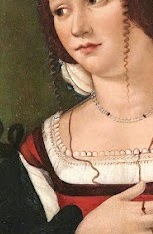 Anna’s supposed desire to be re-instated was so well-known that a booklet was printed in France called the Remonstrance of Anne of Cleves, in which poor Anna lamented her terrible fate in being abandoned by Henry. Anna didn’t have anything to do with the booklet, but it shows she was a figure of sympathy around the world at this time.
I have no direct proof that Anna was behind these requests, but she did move to Richmond Palace during this time to be “closer to the king,” which implies she at least knew of the requests. And she certainly did not speak out against them.
Was it at the behest of her brother the requests were made? Perhaps, but even if it wasn’t Anna behind it, I believe she saw the opportunity it presented. The benefits she would get from securing Henry’s favor far outweighed the public embarrassment of being rejected again by him.

Anna left court after Henry married Kateryn Parr, his final wife. Court gossip said it was because Anna was “jealous” of Henry’s new queen, or that she disliked Kateryn. We have no documentary evidence of that. All we have is a single recorded remark by Anna that "Madame Parr has taken a great burden upon herself" in marrying Henry. Anna knew that better than anyone. She didn’t “court” Kateryn’s favor like she had done with Katheryn Howard.
By all accounts, Anna lived out the rest of her days in England a happy woman. She was the only one of Henry's wives who did.
She died on the 15th or 16th of July, 1557 at Chelsea Old Manor. She was forty-one years old, and had been ailing for some time. Modern historians speculate that she had cancer, but the illness is not named in the contemporary records. She was well enough to make her last will and testament before she died, leaving generous bequests to the servants who tended her. Anna left jewelry to both of the girls who had once been her step-daughters, Elizabeth and Princess Mary - who was now queen. Anna asked that Mary use the rents from one of her estates to settle her debts, and that Elizabeth take one of her maids into her service.

Queen Mary saw to it that Anna was given the royal funeral she deserved, with a full Catholic requiem mass given by Bishop Bonner. (While Anna's faith had always been reformist, she seems to have been content to return to Catholic forms of worship during Mary's reign.) Jane Seymour's sister, the Marchioness of Winchester, served as chief mourner.
Agnes Strickland described it:
Thus they passed St. James and on to Charing Cross, where was met a hundred torches, her servants bearing them, and the twelve bedesmen of Westminster had new black gowns, and they had twelve burning torches and four white branches, then her ladies and gentlewomen, all in black, on their horses; and about the herse sat eight heralds bearing white banners of arms.” These white ensigns were to signify that Anne of Cleves had lived a maiden life.
At the abbey-door all did alight, and the bishop of London and my lord abbot in their mitres and copes received the good lady censing her, and their men did bear her under a canopy of black velvet, with four black staves, and so brought her under the herse, and there tarried dirge, and all the night with lights burning.
The next day requiem was sung for my lady Anne daughter of Cleves, and then my lord of Westminster (abbot Feckenham) preached as goodly a sermon as ever was made, and the bishop of London sang mass in his mitre. And after mass, the lord bishop and the lord abbot did cense the corpse, and afterwards she was carried to her tomb, where she lies with a herse and cloth of gold over her.

The hearse, covered in seven palls of costly fabrics, was looted by the monks of Westminster about a month after her funeral.
The hearse was left, according to custom, some weeks in the church, and Machyn chronicles that when it was taken down it was discovered that the monks had despoiled it in the night of all the velvet cloth, coats of arms, banners, and even the gold fringe of the valance, “ the which was never seen afore so done.” As a matter of fact, the trappings of the hearse were taken by order of the abbot, lest the heralds should claim them. The heralds complained of the loss of their perquisites, but the abbot and sexton appeared before the council and showed grants proving the right of their body to the hearses. Sentence was ultimately given against the heralds.
Mary commissioned a grand tomb for Anna, designed by her countryman Theodore Haveus, but it was never completed. Strickland continues:
Anne of Cleves is buried near the high altar of Westminster Abbey, in a place of great honour, at the feet of king Sebert the original founder.‘Her tomb is seldom recognised. In fact it looks like a long bench placed against the wall on the right hand, as the examiner stands facing the altar, near the oil portraits of Henry III. and king Sebert. On closer inspection, her initials A. and C., interwoven in a monogram, will be observed on parts of the structure, which is rather a memorial than a monument, for it was never finished. “ Not one of Henry’s wives, excepting Anne of Cleves, had a monument,” observes Fuller, “and hers was but half a one.”
Apparently, some work was still ongoing during the reign of James I, but it was probably lack of royal funding which left the tomb unfinished. In the 19th century, a marble panel from it was removed and used in the communion table.
 |
| Couretsey of Westminster Abbey |


