Showing posts with label Elizabeth I. Show all posts

Did Elizabeth Inherit Anne Boleyn's Jewelry?


image
    There seems to be some misconceptions about the possible fate of Anne Boleyn's jewelry, and so I decided to update this article.

    Every queen had a selection of personal jewelry which was not part of the crown jewels. These personal jewels could include gifts from her husband during their marriage, or pieces she owned prior to her wedding. Anne's personal jewelry would not have been considered part of the crown jewels, even after her death and her husband's acquisition of her property.
image


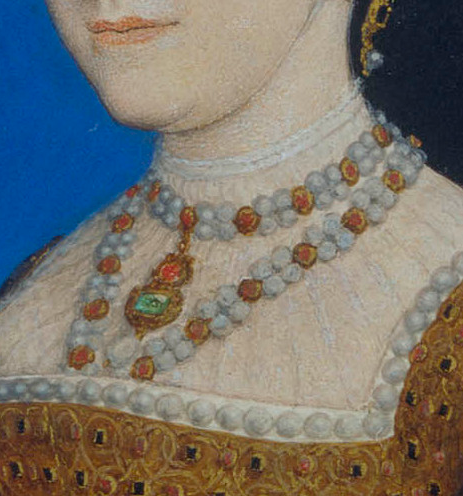
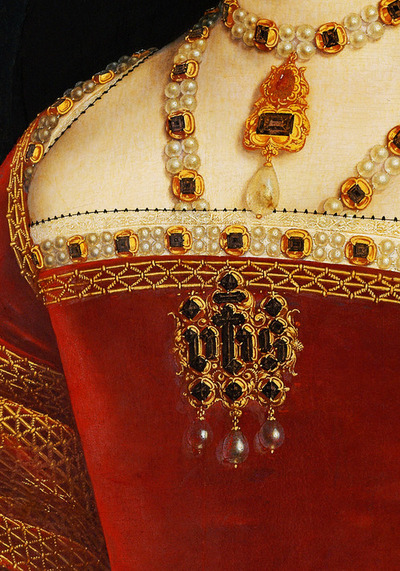
    The crown jewels were a set of gems that were handed down from monarch to monarch. You can see the crown jewels of the Tudor era in the portraits of Henry's queens. The "consort's necklace" is a piece which seems to have been worn by each woman after Anne Boleyn, and it appears not to have been re-set for each queen as many gems were.


    Jane Seymour’s portrait is where it first turns up (though Anne may be wearing it in her portrait medallion with a cross pendant.)

    Katheryn Howard wears it next.
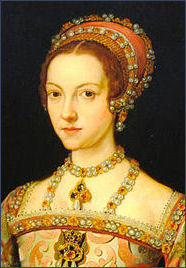

imageimage

After that, Kateryn Parr wore it with a different pendant.


    A particularly fabulous gem might be added to the crown jewels, but that seems to have depended on the monarch who purchased it - whether he or she wanted to "gift" it to the crown - or how it was purchased (whether with the monarch's privy purse or with the funds of the crown.) The current queen, Elizabeth II, owns many fabulous gems - tiaras, and jewelry sets - that have been passed down through her family that are her personal property and not part of the crown jewels.
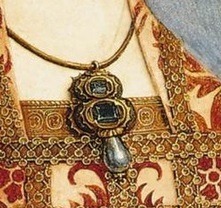


image    When a queen was widowed, she was expected to turn the crown jewels over to the woman who would take her place as consort, but not the gems that were her personal jewelry. Mary Tudor Brandon caused controversy when she absconded with part of the French crown jewels, including the famous Mirror of Naples, and gave it to her brother in a bid to win his forgiveness for remarrying a man of her own choosing. When King Francis asked for the jewel’s return, Henry argued that the Mirror had been a personal gift from the dead king to his sister, and was not part of the crown jewels.


image    Anne's famous initial pendants were an example of personal jewelry. Katharine of Aragon also had personal jewels that were not part of the collection she was forced to surrender to Anne Boleyn in 1532. Specifically, she left to her daughter in her will a "gold collar I brought out of Spain."
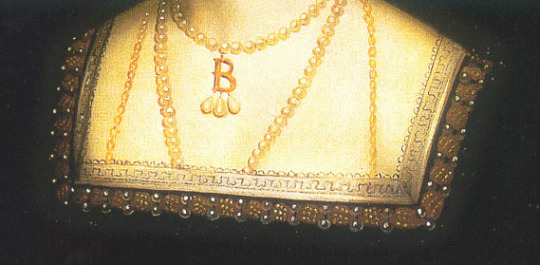


image    The initial pendants I’ve described Anne wearing in Under These Restless Skies are featured in portraits of Anne Boleyn or her daughter. Since no portraits from Anne's lifetime survive (with the possible exception of the Holbein sketch) it seems likely artists painted Anne wearing pieces of jewelry her daughter had inherited, or pieces that were remembered as belonging to her.
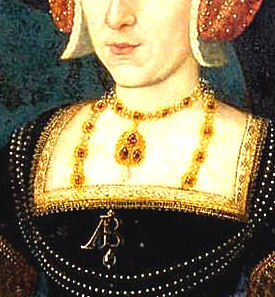


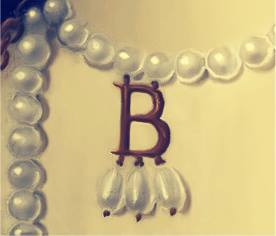
image    Everyone is familiar with the famous “B” pendant, but it appears Anne had several others. 


    “AB,” is pictured in one of her portraits, pinned to her bodice in the Nidd Hall portrait.
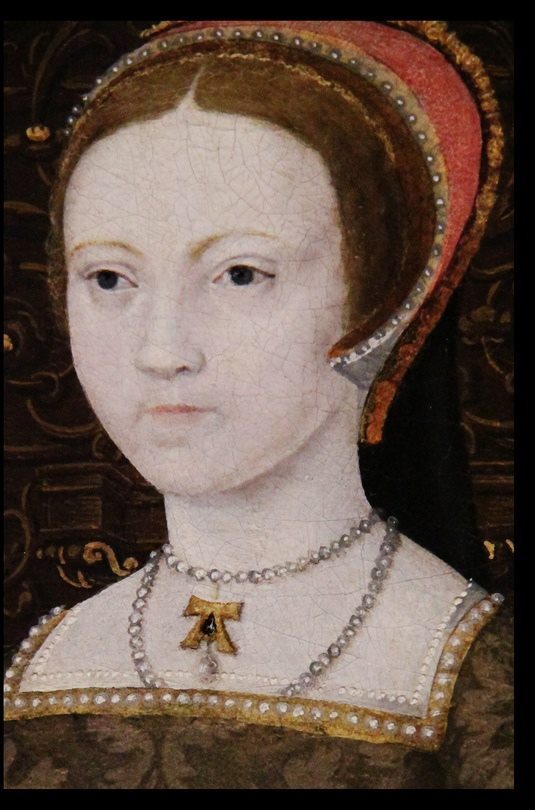


image    An “A” pendant is worn by Elizabeth in the Whitehall Family Group Portrait. (UPDATE: I have been informed that this pendant may have religious significance as opposed to signifying the name "Anne." The pendant may refer to Auspice Maria, or "under the protection of Mary." I need to do further research on this.)
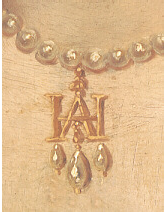


image    Anne is also portrayed wearing an “HA” pendant, her initials entwined with Henry’s, a design known as a love knot. Holbein is recorded to have designed such a necklace for her; it's tempting to imagine this is similar to the one he created. Inventories also record Anne had items with the initials "RA" Regina Anna (Queen Anne) and a large array of rings, bracelets and other items with "HA" inscribed.
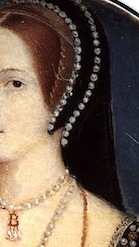


image   It should be noted that some historians now claim the Hoskins miniature, used as the "pattern" for portraits of Anne Boleyn, is actually of Mary Tudor Brandon. However, most nobles of the day did not identify themselves by their surname, but by their title. If Mary wore an initial pendant, it most likely would have had an "S" for Suffolk. Charles Brandon's next wife signed herself "Katherine Suffolk" in documents, just as Anne herself used the name "Anne Rochford" after her father was ennobled, as she signed herself in her only surviving letter to a woman friend, indicating the "B" portrait may portray Anne from a time before that date.
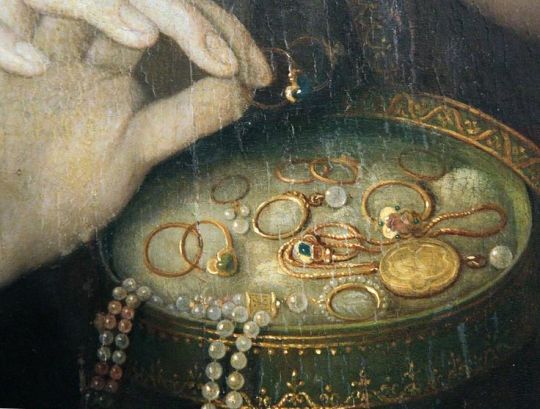


image    What happened to Anne Boleyn's initial pendants? After Anne died, they became Henry's property, both because he was her widower (though he'd had their marriage annulled) and because she was a convicted traitor. The pieces went into Henry's storage. Some of them were noted as still being in his inventories when he died, but not the initial pendants, so they must have been dispersed before his death. Nor do they turn up in the inventories of his queens.
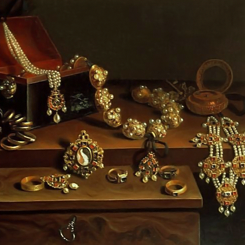


image    At some point, Henry seems to have decided to pass the jewels on to Anne's daughter. They were not only an inheritance from her mother, but they were her Boleyn legacy.  Henry used his daughter Mary's obstinacy as an excuse not to give her the gold collar her mother had left her, but he had no such excuse in Elizabeth's case. Secondly, though he considered her a bastard, Elizabeth was a king's daughter and had to be groomed and bejeweled appropriately. Giving Elizabeth her mother's personal gems would be a cheap way of fitting her out according to her station. Some believe that Kateryn Parr may have intervened to urge him to give Elizabeth her mother's legacy.


    He doesn't seem to have minded her wearing them. Though he had initially tried to eradicate Anne's memory by destroying her portraitsrecords, and emblems, he passed on the gems as they were, not bothering with the expense of re-setting them before he had them given to Elizabeth. Elizabeth chose to wear the "A" pendant in the Whitehall family portrait. Perhaps Henry shrugged and said if she wanted to mark herself with the name of a traitor, it was no skin off his nose. She was a bastard ineligible for the throne anyway.
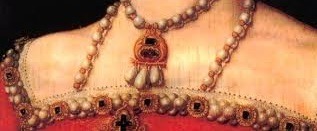


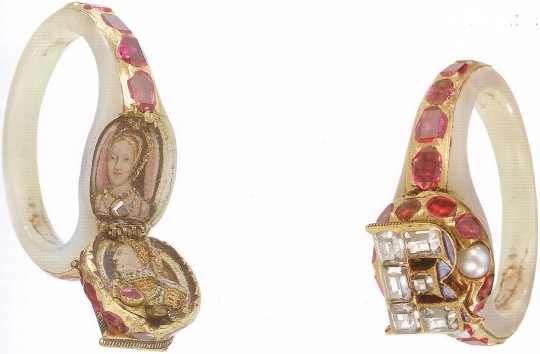
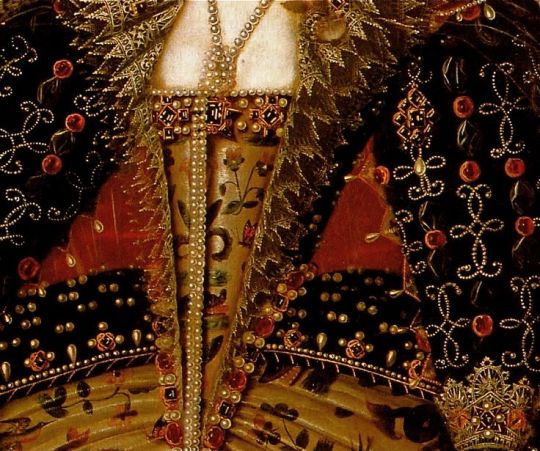
image    Elizabeth may have eventually had the "B" pendant remade into the one we see in her teenage portrait wearing the red gown. Historian Eric Ives notes that he three dangling pearls are nearly identical. Elizabeth is not recorded in her later years as wearing her mother's initial pendants. Perhaps by then she felt it impolitic to associate herself openly with Anne, though she may have worn a crown made for her mother for her coronation portrait, and had a ring made which contains an image of her mother.

image

image    So, what happened next? The Tudors were not as sentimental as we are about keeping inherited jewelry intact. Elizabeth would have done as most people and had the pieces re-made to suit the current fashion. Her mother's pearls may have joined the long ropes she wore looped across her bodices, and the gold may have been recast into brooches or rings.


    They would have gone to James I when Elizabeth died in 1603. His wife, Anne of Denmark, likely had the pieces melted down and re-set again, as was customary with monarchs. Most of the pieces in royal hands were sold off during the civil wars and the Commonwealth era. They disappear into the mists of history.


image
    It's thought that some of Anne Boleyn's pearls may survive today in the State crown of Queen Elizabeth II. However, the crown was made in the time of Queen Victoria, and there's no direct evidence that the pearls belonged to Anne Boleyn or her daughter. StumbleUpon Share on Tumblr

After Anne Boleyn's Execution: Telling Elizabeth

image
    Elizabeth was only two years and eight months old when her mother, Anne Boleyn, died on the scaffold. Anne had provided for her daughter as best she could in the last days of her reign, buying clothing for her - the last Elizabeth would receive for a long while.

image    Elizabeth last saw her mother in January 1536, after the celebrations for Katharine of Aragon’s death. Anne’s expense reports show that Elizabeth was at her own household by January 18. Though Elizabeth would later be told a tale of Anne Boleyn, clasping her baby in her arms and pleading with Henry right before her arrest in May, the story is unlikely to be true.


    Elizabeth was cared for by Sir John and Lady Shelton, along with her governess, Lady Bryan. Lady Shelton was the sister of Anne’s father, and though they shared no emotional affection, she trusted that Lady Shelton would take good care of her baby. And her faith seems to have been well-placed. Though Lady Shelton had been instructed by the king’s council to treat Princess Mary harshly, Lady Shelton stood up to them and insisted that Mary was so virtuous she deserved to be treated with honor and respect.


image
    After Anne was slain, it seems no one told the child of her mother’s death. But the little girl was too intelligent and perceptive not to notice the changes to her lifestyle and the title by which she was addressed. Legend has it Sir John was the one she asked about it.
"How hath it, yesterday my Lady Princess, and today but my Lady Elizabeth?"
    It’s not recorded how Elizabeth reacted to the news. She probably had little emotional attachment to her mother - in her little mind Anne was a nice woman Elizabeth saw on occasion who sent her presents. Lady Bryan was probably the one to whom Elizabeth was most attached. But Lady Bryan was suffering her own loss at the moment, as her husband died only a month after Anne Boleyn went to the scaffold. It must have been a very frightening and confusing time for the toddler.


image    Cromwell had apparently visited Elizabeth’s lodgings after her mother’s fall to give instructions to her household, but there was some confusion amongst the staff about the little ex-princess’s rank, and thus what level of respect she was to be accorded.

image    Worse, no income had been allotted for Lady Elizabeth’s personal needs, and the child had outgrown all of the clothing her mother had made for her before her death. In a letter from August, 1536, Lady Bryan begs Cromwell for help.
. . . My lord, when your lordship was last here, it pleased you to say, that I should not mistrust the king’s grace, nor your lordship. , Which word was more comfort to me than I can write, as God knoweth. And now it boldeneth me to show you my poor mind. [...]
Now, so it is, my lady Elizabeth is put from that degree she was afore; and what degree she is at now, I know not but by hearsay. Therefore I know not how to order her, nor myself, nor none of hers that I have the rule of; that is, her women and her grooms. Beseeching you to be good lord to my lady and to all hers; and that she may have some rayment. For she hath neither gown, nor kirtle, nor petticoat, nor no manner of linen, nor foresmocks, nor kerchiefs, nor sleeves, nor rails, nor body-stitchets, nor mufiiers, nor biggins. All these, her grace’s mostake [”must take” or needs] I have driven off as long as I can, that by my troth, I cannot drive it no longer. Beseeching you, my lord, that you will see that her grace may have that is needful for her,as my trust is ye will do;—that I may know from you by writing how I shall order myself; and what is the king’s grace’s pleasure and yours, that I shall do in every thing.
image

  About two weeks later, Sir John wrote back to Cromwell:
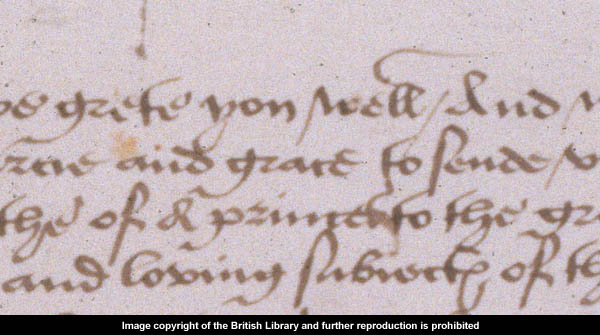
I perceive by your letter the King's pleasure that my lady Elizabeth shall keep her chamber and not come abroad, and that I shall provide for her as I did for my lady Mary when she kept her chamber. Have me in remembrance for the King's warrant you commanded me to deliver to Master Wrisley for money for the household, otherwise I cannot continue it. 
image    Henry seems to have taken out his ill feelings toward Anne Boleyn on their daughter, just as he had once done with Princess Mary. But in Elizabeth’s case, he could not justify it by pointing to his daughter’s willfulness. Elizabeth was an innocent toddler who had done nothing to “deserve” her father’s neglect of her most basic needs.


    Henry’s purpose in confining Elizabeth to her chambers was the same reason he’d ordered Mary into isolation: to keep people from seeing her and hoping she would disappear from the public eye. Poor, friendless, forgotten, Elizabeth would be no competition for the children Henry was sure he would father with Jane Seymour.

    The next time Elizabeth would see her father would be at Christmas, 1536. Mary, restored to her father’s favor through Jane Seymour’s efforts, sat at the high table with him; Elizabeth was seated somewhere out of sight.

    Throughout Elizabeth’s childhood, she was in and out of favor with her father, and it would be Henry’s queens who took pity on her and urged Henry toward grudging kindness to the child. When Anna von Kleefes wanted to bring Elizabeth to court, Henry cited Anne Boleyn as a reason against it, saying Elizabeth had a mother so different from Anna that she shouldn’t want Elizabeth around, but Anna insisted.

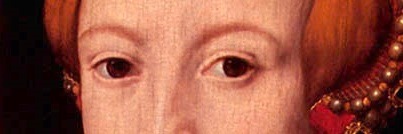
image    Elizabeth made Henry uncomfortable. Every time he saw Elizabeth’s dark eyes, did he think of Anne Boleyn?

    Katheryn Howard made a great effort for Elizabeth because of their blood ties, seating Elizabeth across from her at the dinner table. But it was Kateryn Parr who would prove to be Elizabeth’s greatest ally.


StumbleUpon Share on Tumblr

Anne Boleyn, As a Mother

The birth of Princess Elizabeth Tudor was a crushing disappointment to her mother and a deep, personal embarrassment for her father. Henry had been certain the child Anne Boleyn carried in 1533 would be his heir. A son would be proof of God's favor on Henry's marriage to Anne Boleyn after rejecting his "sinful" union with Katharine of Aragon, which never produced a living boy.

The doctors, astrologers, and soothsayers had all predicted a boy. Only one had been brave enough to say it was a girl Anne carried, and that prediction was not well-received. The birth announcements for a prince had all been drawn up, and celebratory jousts were planned.

When Anne's baby proved to be a girl, it was a shock. Chapuys gleefully reported on Henry's embarrassment, and it was probably true that people may have laughed at the king and his "concubine" who had confidently strutted and flaunted God's favor on their union. The jousts were cancelled and a tiny "s" was scribbled in next to the word "prince" in the birth announcements. Jousts weren't held for the birth of a female; Henry had done the same when Princess Mary was born.

But Henry and Anne did not publicly display any feelings of disappointment. They named the child Elizabeth, the name of both Henry's mother and Anne's. Proclamations went out around England announcing the birth of Henry's first legitimate child, and churches around the nation sang Te Deum in celebration and thanks to God.

There was a grand christening ceremony for
the princess on September 10, with the highest nobles in the land present. The christening gown that Anne made and embroidered for Elizabeth supposedly still survives, having been given to Kateryn Parr and passed down through her family. (Its authenticity is in question.) But Anne is known to have sewn and embroidered many items for her baby.

Babies of that era were swaddled tightly. Elizabeth's cradle would have been gilded, carved and painted. There's an order in Anne Boleyn's expense records for red damask to make Elizabeth's bed covers, and crimson fringe for the head of her cradle.

Anne Boleyn, by all accounts, was a very loving mother. An old story claims that Anne wished to breastfeed Elizabeth personally, but Henry wouldn't allow it. The story demonstrates that Anne's love for her daughter might have been widely known, but it has no basis in fact. Highborn women did not breastfeed their own children - especially queens - and Anne followed royal protocol to the letter. Noble mothers showed their love and concern by choosing the best possible wetnurse for the task, someone who had a proven track-record of healthy babies. Secondly, Anne wanted to get pregnant again as quickly as possible, and breastfeeding was known to reduce fertility.

Other stories tell us of Anne's love for Elizabeth. It's said she kept the baby with her during the first few months of Elizabeth's life, lying on a cushion next to her instead of shut away in the nursery.

Elizabeth was sent away to her own household at Hatfield on December 10, 1533. We can only wonder how Anne felt about this, but she did her duty. Nobles of the era did not raise their own children. Anne had done what she could in choosing the best people to take care of her baby. Many of them were her relatives by blood or marriage.

Along with them went Henry's other daughter, Mary, forcing her to serve the infant sister who had supplanted her in rank. Anne must have been anxious about that, but Mary loved her baby sister and took wonderful care of her, despite her misery in her living conditions.

Princes and Princesses of the era had their own palaces and armies of servants. From birth, they had the same household as an adult prince or princess, even though some of the servant's services would not be utilized for decades. A place at the table was set for the princess, though she would not sit there for years, and meals suitable to her royal dignity were served, though they ended up being consumed by the upper servants in her stead.

Anne's expense records are full of purchases for her daughter. She wrote to Lady Bryan, Elizabeth's nurse, frequently. None of the letters survive, but we know Anne kept in close contact with those charged with her daughter's care. Henry ordered Elizabeth weaned when she was two years and one month old, and noted in his order that Anne was enclosing a letter, likely with further instructions and advice.

She also visited Elizabeth when she could steal some time away from her duties, and the princess was brought to court for holidays and special occasions. When Katharine of Aragon died in January, 1536, Elizabeth made her last appearance at her mother's court, as Henry paraded her around and showed her off to his courtiers.

Only a few days before her arrest, Anne went to her chaplain, Matthew Parker, and extracted from him a promise to look after her daughter if anything happened to her. Parker took that promise seriously and spent the rest of his life trying to fulfill it. The power of Anne's love survived her death, and she was able to protect her daughter beyond the grave.

StumbleUpon Share on Tumblr

Did Elizabeth I Ever Visit Anne Boleyn's Grave?

Elizabeth wearing one of her mother's
initial pendants, a letter "A"
Queen Elizabeth I seems to have had an aversion to tomb-building. Unlike most long-lived monarchs, she never began building her own tomb in her lifetime. Nor did she ever build the tomb her predecessor, Mary, asked for in her will (which Mary wanted to share with Katharine of Aragon, who never got a tomb, either.) Nor did Elizabeth build one for her little brother, the short-lived King Edward VI, or finish constructing the tomb for her father, Henry VIII. So, perhaps it's not surprising she never moved her mother from her grave in the chapel floor of St. Peter-ad-Vincula in the Tower of London.

From the ring she always wore that secretly concealed her mother's portrait, and the favor she showed her maternal relatives, Elizabeth held her mother's memory in honor, though she could never publicly speak about Anne Boleyn. To decree that her mother was innocent would be to defy her father, and the justice system as a whole. Some of the lords on the jury that condemned Anne were still living, and to say their verdict was unjust would be to call their integrity into question. It was a can of worms Elizabeth just couldn't open.

Courtesy of Findagrave.com
Though she never built a better tomb for her mother, did Elizabeth ever visit Anne Boleyn's grave in the Tower?

When Elizabeth was a prisoner there under the reign of her sister, she probably was never given the opportunity. There is some debate as to whether she was imprisoned in the Bell Tower or the royal apartments (which are no longer extant.)

In either case, she was eventually given a small measure of liberty to walk around the top of the wall or in the garden behind the royal apartments, but she would not have been allowed to walk all the way across the Green to the chapel. She would not even have been able to see the chapel, if she was lodged in the queen's apartments.
Map of the Tower of London in Elizabeth's day
with locations marked in color
The royal apartments are marked in red
The Coldharbor Gate is marked in green
The Bell Tower is marked in purple
St. Peter-ad-Vincula is marked in blue
The site of the scaffold would have
been to the right of the blue arrow

As queen, Elizabeth only stayed at the Tower of London a few times, probably because of its ugly memories and association. She stayed for a several days when she took symbolic possession of the Tower upon ascending to the throne in late November, 1559 and then the night before her coronation ceremony, as was the tradition. She left on the morning of her coronation and to my knowledge, never returned.

We have no record of Elizabeth ever visiting the chapel of St. Peter-ad-Vincula, but that's not certain proof that she didn't. But it wouldn't ordinarily be a place that a king or queen would go, and so it would have required a special trip, and thus been notable.

Elizabeth would not have attended religious services St. Peter-ad-Vincula, which was essentially a parish church for the soldiers, servants, and their families. The royal family worshipped at the Chapel of St. John on the second floor of the White Tower, or Elizabeth could have a private service in the chapel of the royal apartments (where Anne Boleyn received her last communion).

St. Peter-ad-Vincula was on the other side of the Tower from where the royal apartments were located, which meant a quiet private visit could not be accomplished. To get there, Elizabeth would have had to march past the Jewel House with its staring guards, through the Coldharbor Gate, across the wide expanse of the Green, trailing a large herd of ladies-in-waiting and curious courtiers. It would have caused a stir of gossip, something Elizabeth was trying hard to avoid.

With these factors in mind, it's unlikely Elizabeth ever visited Anne Boleyn's grave. But she honored her mother's memory in many other ways.


StumbleUpon Share on Tumblr

September 7, 1533: The Birth of Elizabeth I

It must have been miserable!

Anne Boleyn had "taken to her chamber" on August 26, 1533 to be sealed away from the world until after the birth of her child. She was led in a solemn procession to her chamber door, where she drank a goblet of spiced wine, and then proceeded inside with her ladies. The door was sealed shut; no men could enter until after the birth of the new heir.

Anne had no choice but to obey the conventional rules for royal childbirth. They had been codified by the king's grandmother, Margaret Beaufort, when she wrote Ordinance as to What is to be Made ​​Preparation Against the Deliverance of the Queen, as Also for the Christening of the Child of Whom She Shall Be Delivered for the delivery of the child of her daughter-in-law Elizabeth of York, wife of Henry VII.

The Ordinance is minutely detailed, down to specifying the colors of the fringe on the bedspread of the queen. You can read the whole Ordinance here.

The walls - and even the ceiling - were covered with tapestries, and the floors were laid with layers of rugs. All of the tapestries were required to have pleasant scenes, because if the expectant mother saw an ugly or deformed face, it was believed her child could be born with the same deformity.

Every window was covered over with a tapestry nailed down to keep out the foul "miasmas" in the air, except for one tapestry left partially unfastened, so the queen could lift the corner to allow in some daylight when it pleased her. Even the keyhole on the door was covered.

Anne followed these rules obsessively, not just because of her queenly status, but because if something went wrong, she would have been blamed for it, and any deviation cited as the cause.

It was late summer, and since the windows were sealed against any cooling breeze, it must have been stifling. The incense and heavy perfumes - thought to purify the air of foul miasmas - probably didn't help.

Boredom had to have set in, as well, though the women played cards, read, played musical instruments and embroidered while they waited for the birth. Anne had to be anxious - kings usually took a mistress while their wives were expecting. Sexual intercourse during pregnancy was not only considered sinful, it was thought to induce miscarriage.

Anne had a chapel set up in her chambers, complete with a baptismal font in case the infant was dying and needed emergency baptism. As she prayed for a safe delivery, did her eyes drift to that grim reminder of mortality?

Traditionally, a woman went into confinement about a month before the child was due, and remained inside the lying-in chamber until she was "churched" about forty days after the birth. Fortunately for Anne, her confinement was much shorter than expected. Everyone was shocked when she went into labor a scant two weeks after taking to her chamber.

The birth itself went well. Like almost every other aspect of life, Tudor royal births were semi-public events. All of Anne's ladies in waiting and maids of honor watched as she was settled on a cot where most of her labor would occur.

There were no painkillers available to Tudor women. Wealthy ladies used to send for relics of the saints which were said to reduce the pain of childbirth and ensure a healthy child. Henry's mother, Elizabeth of York, sent a girdle (belt) to a church to be wrapped around the statue of a saint. When the labor began, it was taken off the statue and brought to her, and she laid it across her belly.

But by this time, many of the famous relics had been denounced as frauds and removed from the churches. Anne had only the prayers of her ladies for assistance, and her "gossips," who told entertaining stories to try to distract the laboring woman from the pain.

When the actual birth itself was near, Anne was transferred to a "groaning chair." It was a slightly-slanted wood chair with a cut-out seat. The midwife held her hands below to catch the emerging child.

At three o'clock, the baby was born, and to her parents' dismay, she was a girl. Henry must have been stunned. For Anne Boleyn, he had destroyed a thousand years of English religious tradition and defied the crowned heads of Europe, only to get another worthless girl. So confident was he that Henry had birth announcements drawn up, announcing the arrival of his prince, with only the date left blank for later insertion. He had believed God would show his approval of Henry's actions by sending him his heir, and he had believed what the fortune tellers promised him. Later, he would tell the Imperial ambassador, Eustace Chapuys, that those soothsayers' predictions had induced him to marry Anne, and when their prognostications turned out to be false, he thought it meant his marriage was null and void.

The alteration is on the third line down.
There must have been many who laughed behind their hands at this outcome. All this for another girl! But Henry gritted his teeth and smiled. The child was healthy; the next one would be a boy. They named her Elizabeth, after her grandmothers, Elizabeth of York and Elizabeth Howard Boleyn.

The celebratory jousts were cancelled, and the birth announcements were altered. A tiny "s" was slipped in to turn the word "prince" into "princes," an acceptable spelling of princess at the time, though people must have squinted to read it.

Anne was tucked into a great bed of estate, covered with cloth of gold and ermine. There, she would receive the congratulations of the court and foreign dignitaries. She would still have to remain in seclusion until after she'd been "churched," ritually blessed and allowed to rejoin court life.

Neither of her parents attended Elizabeth's christening three days after her birth. You can read a first-hand account of the christening here. The Dowager Duchess of Norfolk, Agnes Tilney Howard, carried the baby into the chapel of the Observant Friars in Greenwich Palace, accompanied by a huge procession of the highest nobles of the land, bearing torches and candles. The baby wore an elaborately embroidered gown made for her by her mother. It supposedly still survives at Sudeley Castle, having been given to Kateryn Parr and passed down through her descendants.

A wetnurse was selected for the baby. There's an apocryphal tale that Anne Boleyn wanted to nurse the baby herself, but the king refused. I included it in Under These Restless Skies, but it's likely not factual. Anne would have wanted to become pregnant again as soon as possible, and nursing was known to reduce fertility.


Selecting a wetnurse was a difficult task. She had to be of fine moral character, because vices were thought to be transmitted through the milk. It was better to have a nurse who had given birth to a boy herself, because it was believed the milk a woman produced for a boy was of better quality. Her diet had to be carefully monitored to ensure she made the best milk possible.

The baby would have been tightly swaddled and dressed in fine clothing, miniature versions of the bejeweled gowns worn by the lords and ladies of the court. Her rattles would have been made of solid gold and ivory. Tiny rings would have adorned her fingers, and pearls gleamed from the brim of her cap.

The baby was soon sent off to her own household in the country, complete with hundreds of servants as befitted the royal heir.

Anne kept close tabs on her daughter, visiting her as frequently as possible, and writing every day to her nursemaids to see how she fared. She sent the baby sumptuous gowns, likely made by her own hands. Historians note Anne seems to have been very affectionate and attentive to her baby, more so than usual. StumbleUpon Share on Tumblr