Showing posts with label Life in the Tudor Era. Show all posts

Did Anne Boleyn Have a "Fair Trial"?

On May 15, 1536, Anne Boleyn and her brother, George, were convicted of adultery and incest and sentenced to death.

To modern eyes, what happened to those swept up in Anne Boleyn's fall is appalling, a gross miscarriage of justice. Even five hundred years later, we have documentary evidence to prove the charges in the indictment false. But according to the standards of the day, the criminal trial was fair and followed the standard legal procedures. King Henry wanted everything to be strictly "by the book." He knew the eyes of the world were watching this stunning course of events, an anointed queen on trial for treason.

In the Tower after her arrest, Anne Boleyn asked her jailor, William Kingston if she was "to die without justice." Kingston replied that even the poorest of the king's subjects had justice. Anne is recorded to have laughed at that, and some interpret that to be her ironic acknowledgement that the "justice" she was to receive was merely a formality before the inevitable execution.

If the letter "From the Lady in the Tower" is to be believed, Anne hoped an "open trial" would allow her to prove her innocence before the world. But it doesn't seem Anne ever had any doubt she and the others would be found guilty.


In the Tudor era, there was no presumption of innocence. 

The accused had the burden of proving their innocence, but the design of the judicial system made that almost impossible.

The preliminary court investigated the allegations, heard testimony and questioned witnesses. They presented their findings in the indictment. The indictment was taken as more-or-less established fact by the trial court, not something to be challenged by the defendants on an evidentiary basis. The question before the trial court was how the accused would respond to these facts.

For the most part, people believed the accused had to be guilty, or they wouldn't have been charged with the crime in the first place.

Many believed if a person was truly innocent, God would intercede with a miracle to prove it. Anne herself may have believed this, as evinced by her statements to William Kingston that it wouldn't rain until she was delivered from the Tower, or if she died, there would be a great punishment visited on England within seven years.

As John Strype explains it:

... thinking probably that God (who takes care of innocency) would vindicate her, by giving, or withholding the clouds of Heaven. [...] This she spake no doubt in the confidence of her innocency; and God's righteous and visible judgments for the most part, for shedding innocent blood. And indeed within the seventh year following, happened a dreadful pestilence in London, and many commotions and insurrections to the end of this reign.

The jurors were selected by the prosecution. 

Out of the fifty-plus peers in England, twenty-six were summoned. Many were hostile to the Boleyn and Howard families for one reason or the other, or owed their positions to the king's favor. In short, they were selected because they could be relied upon to deliver the verdict the king wanted. This was standard procedure.

Had the jury returned a verdict the monarch deemed "contrary to the evidence," the jurors could be fined or imprisoned. It wasn't a frequent occurrence, but it did happen. There's no doubt that was on the jurors' minds when they sat in judgement on the queen the king obviously wanted to be rid of.

It was also lawful to try a defendant again for the same crime if they were acquitted. William Brereton once convinced the king (supposedly with Anne's help) to re-instate murder charges against a man who had killed one of retainers. The man was convicted and hanged the second time around.


The accused had no advocates or legal representation to assist in their defense. 


The chief justice of the trial was ostensibly supposed to ensure that the proceedings against the accused were entirely lawful and did not impugn the few rights a defendant had. William Hawkins explained the reasoning behind this in 1721 when he wrote that if the accused was innocent, they would be as effective as any lawyer, but if he was guilty, his demeanor and speech would reveal it.

Consider that most common defendants might be kept in a squalid prison for months, where they had to pay for their own food, bedding, and water for washing - then brought before the court filthy and starving, and expected to answer eloquently to charges they had just heard for the first time. The nobility had the advantage of comfortable conditions, but they didn't necessarily know the law well enough to ague effectively in their own defense.


The accused did not know the charges until the trial began.

Until the 1600s, there was no precedent for allowing the accused to know the charges for which they were to stand trial until the day they stepped into the courtroom. In other words, they were forced by the nature of the system to come up with a defense on the spot.

Most defendants were imprisoned before the trial, and held incommunicado. The could not gather evidence on their own behalf beforehand, nor call for witnesses to come and help them defend themselves.

Had Anne Boleyn known the charges beforehand, and if she had access to her own records, she could easily have proven she was not in the locations where the alleged offenses took place and could not possibly have committed the crimes.


No witnesses were called. 

All of the witnesses had already given their testimony and been questioned by the preliminary court which had drawn up the indictments. There was no chance for the defendant to cross-examine them.

The sworn depositions of the witnesses were considered - essentially - an established fact beyond question.

In 1571, during the trial of the Duke of Norfolk, the Duke tried to question the testimony of one of the witnesses. One of the judges retorted"He is sworn, there needeth no more proving." 

The notion that sworn testimony was somewhat sacrosanct lasted for a long time within the English legal system. The law held that no one would dare to swear falsely for fear of the punishment God would unleash upon them.

To avoid the somewhat sticky situation in which defendants denied sworn testimony, the defendants were not sworn. But without the oath, their words had less weight than those of the sworn witnesses for the prosecution.

In 1554, defendant Nicholas Throckmorton attempted to bring in witnesses to testify on his behalf, but the witnesses were not "suffered to speak." When Throckmorton tried to protest, the chief justice on the case told him he had no grounds for complaint, for he had been permitted to speak in his own defense as long as he liked.


Hearsay was accepted as evidence.

We don't know what Lady Bridget Wingfield supposedly said on her deathbed, because the trial records do not survive. Years after her death, Bridget's husband - known to be hostile to Anne Boleyn - appeared at the trial to recount the statement as evidence for the prosecution.

Lancelot de Carles claims some of the major testimony against Anne Boleyn came from Sir Anthony Browne (as identified by John Hussee), who reported Browne had chided his sister - the Countess of Worcester - for appearing promiscuous, and in response, the Countess claimed the queen's behavior was worse.

Browne reported the Countess had told him Anne allowed men into her room at inappropriate times, and accused Anne of incest with George. There is no mention of the Countess being questioned or testifying directly about these matters - nor of the fact that the Countess secretly owed Anne a substantial amount of money, unbeknownst to her husband.

The last piece of hearsay evidence comes from the trial of George Boleyn. He was handed a piece of paper with the last charge of the indictment written upon it and cautioned to read it silently. George defiantly read it aloud. It was a claim that his sister had told Jane Parker the king was impotent. It does not appear that Anne herself was asked to corroborate whether she had said this to Jane.


There was also no right to remain silent, or to protect a defendant against self-incrimination. 

The panicked babble of Anne after her arrest was used as evidence against her in the court. Indeed, Anne's arrest seemed to be engineered in order to take advantage of this trait she had of talking without guarding her words when she was frightened. Orders were given that every word she spoke was to be recorded, and her ladies were never to speak to the queen without Lady Kingston being present.


Testimony derived from torture was legal.

It's believed Mark Smeaton was tortured - or threatened with torture - in order to force a confession that he was Anne Boleyn's lover. George Constantine, the servant of Henry Norris, wrote about:

the saying was that he [Mark] was first grievously racked, which I never could know of a truth.

Torture was believed to be a tool for compelling "obstinate" persons to reveal the truth. It wasn't used as a punishment, or sadistic intent, but rather as a way of forcing the accused person to acknowledge what the prosecution believed to be factually established guilt. "Whereby he may be the better brought to confess the truth," one warrant reads. Another, written by Queen Elizabeth within a few months of her ascension, authorizes a man


to be brought to the rack, and to feel the smart thereof as the examiners by their discretion shall think good, for the better of boulting out the truth of the matter.

In the official records, warrants authorizing torture in criminal trials were issued eighty-one times between 1540 and 1640. There are undoubtedly more that aren't accounted for because of missing documents, gaps in the record and so forth. Certainly, a warrant for the torture of Mark Smeaton does not exist, but it could be part of the records of Anne Boleyn's trial which were apparently destroyed.

The nobility was exempt from the threat of torture. Only Mark Smeaton was eligible. It's probably not coincidental that Mark was the only one who confessed.

The threat of an incredibly painful death was probably also a factor. As a commoner, Smeaton would have experienced the full horrors of being drawn and quartered. In exchange for his confession, his sentence would be commuted to simple beheading, alongside the gentlemen. He may have needed no further incentive.


In short, there was little chance Anne Boleyn or any of her accused lovers had a chance of being found not guilty. 

In court, Anne and George gave the eloquent, "intelligent and plausible" defense of the innocent that was supposedly as good as a lawyer's assistance, but it availed them nothing. They were both found guilty, as Anne knew they would be. (In her post-conviction speech, she regretted her innocent brother would die with her, though he had not been put on trial yet.)

They were all encouraged to confess and throw themselves on the mercy of the king, but except for Smeaton, they all insisted upon their innocence. Norris, it's said, even offered to defend Anne's honor in a "trial by combat," an old legal tradition in which it was believed God would protect an innocent man and allow him to triumph in single combat.

Historian John Strype claimed to have seen a letter from Anne to Henry in which she angrily rejected a plea bargain which would require her to confess, and would insist upon her innocence, even if it meant death. Norris also is quoted as saying he would rather die a thousand deaths than condemn an innocent woman through falsehood.

Anne Boleyn did the one thing she could to restore her reputation, something even more powerful than the oath sworn by her accusers: she swore on the sacrament that she was innocent, both before consuming it, and afterward. The Tudors believed lying on the host merited instant damnation, an unforgivable sin. Anne would never have falsely sworn her innocence right before meeting her Maker. She called Kingston to witness it to make sure it would be recorded - just as her panicked words after her arrest had been - but this time, she would use that system to grasp the only vindication she could.

It was the only vindication she would get. She had hoped the trial would allow her to prove her innocence to the world, regardless of the actual verdict. However, none of the transcripts of the trial, examinations, or depositions survive. It's rather curious, for the records of the investigation of Katheryn Howard survive intact. But of Anne's trial, we have only the salacious indictment, and the verdict, slightly augmented by eyewitness testimony.

It's speculated the records were purposefully destroyed because the lack of evidence against the queen was troublesome, even given the lax standards of the day. It seems whomever destroyed them was relying on posterity continuing the contemporary presumption that a person charged with a crime must be guilty of it. They seem to have hoped Anne Boleyn would simply fade from the records and be forgotten as a shameful blot on history. They could never have anticipated our enduring fascination with her. Perhaps this, then, is the miracle Anne Boleyn hoped for. StumbleUpon Share on Tumblr

The Cult of Celebrity in the Tudor Age

So we’ll live, and pray, and sing, and tell old tales, 
and laugh at gilded butterflies, 
and hear poor rogues talk of court news, 
and we’ll talk with them too—
Who loses and who wins, who’s in, who’s out—
And take upon ’s the mystery of things
As if we were God’s spies. And we’ll wear out
In a walled prison packs and sects of great ones
That ebb and flow by the moon. 

-From William Shakespeare's King Lear, Act V, Scene III


.¸¸•.¸¸.•´¯`• (¯`•♔•´¯)•´¯`•.¸¸.•.¸¸.


We tend to think of things like celebrities and gossip as something modern, but the truth is that while times may change, people never do.

The nobility were the celebrities of their day, and the average Englishman was probably just as much aware of their comings and goings, intrigues and alliances, as someone living at court. Gossip was a beloved English pastime. Gathering in a tavern to drink and trade gossip was a pleasant way to pass an evening.

The nobility had no privacy. Every moment of their lives was played out in front of servants who derived part of their income from the gifts and bribes they were given to spread the news of the noble's health, quarrels, alliances, friendships, business deals, and aspirations. Even details that we would consider extremely personal information ... Women's laundresses were frequently bribed to find out if they were still menstruating.

Gossip was a vital asset in the cronyistic system. Knowing who was in favor - and who was on the outs - let those seeking favor know whom they needed to bribe. Everything from court cases to land deals was predicated on having the right noble's favor. At the court of Henry VIII, favor could literally turn overnight, and so having the most up-to-date news was vital.

There was an order to this system, a sense of what was a fair level of compensation for a service rendered. Cromwell once received a letter complaining about one of his commissioners working on the suppression of the monasteries:

The man is young and of intolerable insolence. In his visitation he refuseth many times 'his reward' [bribe], though it be competent, or that they offer him so little, and maketh them send after him such rewards as may please him.

Letters, like those of the Lisle family, helped gossip spread far and wide through the kingdom. Honor Lisle hoped to get her daughters appointed to court, so she sent gifts to the queen and her favorite courtiers, hoping one of them might petition the queen for her.

Eustace Chapuys was essentially the scandal rag of his day. He reported scandal and gossip in his dispatches back to the court of Emperor Charles V, without much effort at determining the truth, especially if it was gossip about someone he disliked. Unfortunately, a great deal of our knowledge of the court comes from his letters, so it's much like historians five hundred years from now reading the a celebrity gossip magazine to learn about the history of our day. The Spanish Chronicle codifies many of these rumors into a narrative form. It's of interest simply to know what stories were circulating in the court, but of little value as a historical document. Chapuys himself should be treated with skepticism, but some historians have taken his reports at face value.

Will Somers had his own booklet 
printed about him in the 17th century, 
a biography called A Pleasant Historie 

The forerunner of gossip mags were printed pamphlets or books with engraved images of Tudor celebrities. Nobles, executed criminals, court officials, and military heroes were frequently featured. They were sold as souvenirs at executions by strolling merchants, and stocked a stationary shops in the cities.

Ballads and popular songs were another way gossip was spread and chewed over by the people. While Anne Boleyn was still in the Tower, Henry VIII warned Jane Seymour that there was a satirical song making the rounds that mocked Henry's callous behavior and relationship with Jane:

Advertising you that there is a ballad made lately of great derision against us, which, if it go abroad and is seen by you, I pray you pay no manner of regard to it. I am not present informed who is the setter forth of this malignant writing, but if he is found out, he shall be straightly punished for it.

The song is lost to the mists of history. The king's agents likely destroyed any written copies of it (assuming there were printed copies) and none of them have survived to the current day.

Another ballad or poem about Anne Boleyn's woeful fate is O Death, Rock me Asleep. It is often attributed to Anne herself, supposedly having written it in the last few days before her execution. But this is unlikely. As historian Eric Ives noted, William Kingston - instructed to write to the council about every word Anne spoke - never mentioned her writing or composing a poem. A copy of it is found in a manuscript which is roughly contemporary, so it had to be composed very near the time of Anne Boleyn's death, but not likely by the queen herself.

While the common people might chat, sing, or read about these Tudor celebrities, actually seeing one of them was rare, just as most modern people will never glimpse a movie star in the flesh. The common people of the era rarely traveled more than a few miles away from their home village. The only time it might be possible to see the nobility was when court passed by on royal progress.

When the court went on progress, traveling around the countryside, the common people would travel from miles around to line the roads to watch the passing show of the hundreds of colorful wagons, servants, and nobles on horseback or litter.

The people would cheer for their favorite nobles, and pass them petitions and gifts. But having likely never seen an image of them, the people would need something else in order to be able to identify them. In a mostly illiterate society, nobility would be identified by their family coat of arms, painted on their wagons and worn on their servants' livery. The people would call blessings, and in return, the nobles would sometimes distribute coins to the people. It was very exciting for the populace. It might be the only time they ever saw these exalted personages they'd heard so much about. StumbleUpon Share on Tumblr

Was Anne Boleyn a Victim of Sexual Harassment in the Workplace?

Karen Lindsey, author of Divorced, Beheaded, Survived: A Feminist Reinterpretation of the Wives of Henry VIII puts forth a very interesting opinion on the way we should view Anne Boleyn's time at court:

I was doing an article for Ms. about sexual harassment on the job and reading about Henry's wives in my free time, but it took a while to put together the fact that Ann Boleyn's position as lady-in-waiting to Henry's wife Catherine of Aragon was her job, and that, far from trying to lure Henry away from Catherine, she had spent over a year tactfully trying to repel his sexual advances. 
[..]
Today, Henry’s approach to Ann would be instantly identifiable as sexual harassment. Ann however, had no social or legal recourse against a the man who ruled the country. She continued, as so many women before and since have done, to dodge her pursuer’s advances while sparing his feelings. It didn’t work.
[...] 
It was a hellish position. Could she really tell the king to his face that she had no interest in him? She could reiterate her desire to keep her chastity and her honor, but clearly he didn’t respect that. She could ignore his letters and stay away from court, but he refused to take the hint. To offer him the outright insult he asked for would be to risk not only her own but her father’s and brother’s careers at court. She undoubtedly kept hoping he would tire of the chase and transfer his attentions to some newer lady-in-waiting.
But he didn't and she was trapped; there was no chance of her making a good marriage when every eligible nobleman knew the king wanted her.

Lindsey is correct that Katharine of Aragon's court was Anne's workplace. Service in a noble court was the 16th century's version of the corporate ladder.

The world of the nobility was a system of intricate social stratification where everyone sought employment from the rank above. The Babee's Book laid out this chain of service in example:

Even the duke's son preferred page to the prince, the earl's second son attendant upon the duke, the knight's second son the earl's servant, the esquire's son to wear the knight's livery, and the gentleman's son the esquire's serving-man. 

Those who were charming, talented, clever, or amusing, could be promoted with additional job duties and income, or move up to the household of a noble higher in rank. 

The duty of service to one's betters was bound up in religious faith. The Tudors believed that God had ordained the social order of the world. A person's status was the position to which God had called them, and so service to their superiors was as service to God.

Only those of the highest pedigree and social connections could hope to find a job serving the king or queen. Anne Boleyn was not titled, but she was the granddaughter of a duke. Her father was a very wealthy and well-connected man who had served as the king's ambassador, and Anne's mother had served Elizabeth of York. Securing Anne a job as a lady in waiting to Queen Katharine was a boon for their family.


Anne was employed in a series of royal households from the time she was a very young child, learning the social graces that would entertain those who employed her. She could dance, play instruments, engage in witty conversation, and was well-read enough to debate on intellectual topics. She was the consummate professional in her work, and remained chaste while she waited for her father to arrange a good marriage for her.

At one point, Anne took the bull by the horns and tried to arrange her own marriage with the son of the Earl of Northumberland. The results were disastrous, as far as her career was concerned. Once it was discovered what she was doing, she was banned from seeing the young man again and sent home to Hever in disgrace. She was fired, in other words.

Her family must have been livid. The match her father had been working on - perhaps unbeknownst to Anne - fell apart. Some scholars believe it might have had something to do with Anne's failed betrothal, but no records exist to explain it. The Butler family may not have wanted the union in the first place, which might have been engineered by Cardinal Wolsey to resolve an inheritance dispute. In any case, Anne now had no job, and no prospects for a husband.

Anne returned to court about a year later. We know nothing of the next two years or so, except what fragments can be deduced from the memories of Thomas Wyatt, as related by his grandson

There was, at this present, presented to the eye of the court the rare and admirable beauty of the fresh and young Lady Anne Boleigna, to be attending upon the queen. In this noble imp, the graces of nature graced by gracious education, seemed even at the first to have promised bliss unto her aftertimes. She was taken at that time to have a beauty not so whitely as clear and fresh above all we may esteem, which appeared much more excellent by her favour passing sweet and cheerful; and these, both also increased by her noble presence of shape and fashion, representing both mildness and majesty more than can be expressed.

She seems to have been very popular at court. Northumberland's son wasn't the only man who was attracted to Anne. Thomas Wyatt fell in love with her, according to his grandson's book, and several of Wyatt's poems seem to refer to Anne and his unrequited passion for her. But Anne was cautious of her reputation, and rejected Wyatt's advances.

King Henry seems to have noticed Anne in late 1525/early 1526. His favor came with a "promotion" offer for her: an appointment to serve his wife, Katharine of Aragon. Anne wrote the king a letter, thanking him for the appointment. But this promotion came with some drawbacks.

As Karen Lindsey notes, Anne was in a very delicate situation with Henry's favor. Having his interest meant her family's advancement, and indeed, her father and brother received a steady series of gifts, grants, properties and titles, including his long-desired title of Earl of Ormond. Anne herself was showered with gowns and jewels, and fawned over by the court, seeking her favor so she might help advance them as well. Rejecting the king outright would have cut off this flow, and perhaps even set the Boleyn family back to being worse off, if the king became angry about it.

  In February 1526, Henry made a public declaration of his interest in Anne, hoping the fawning attention of the court would pressure her into giving into his advances. Anne was suddenly thrust into the international spotlight as Henry's love interest, and suddenly had dozens of new "friends" seeking her favor and trying to use her for their own advancement. And, of course, they encouraged her to accede to the king's wishes. But Anne held firm to her principles. She would not sleep with any man outside the bonds of holy matrimony.

Henry now spent more time in his wife’s quarters than he had in years, but it was to visit Anne where she couldn’t escape his attentions.

In May, it got so bad that Anne actually quit her job as a lady in waiting and retreated to Hever, where she refused to answer Henry’s letters and sent back his gifts. Henry’s letters to her at this point are full of pouting complaints that she won’t write back to him. He claims not to understand it.

I cannot sufficiently marvel at, because I am sure that I have since never done any thing to offend you, and it seems a very poor return for the great love which I bear you to keep me at a distance both from the speech and the person of the woman that I esteem most in the world...

Henry still wouldn’t take “no” for an answer and chased after her. He went to stay with a cousin of Anne, Nicholas Carew, whose house was a convenient distance from Hever so he could ride over at his leisure. Anne could not refuse to receive him at the house. She refused wherever she had agency, but in this she did not. No one could refuse the king admittance.

When Anne did return to court, she had to face a great deal of hostility. Those still loyal to Katharine of Aragon despised Anne for "luring" the king away from his wife. Anne had enemies she'd never even met, people who hated her for everything she represented, who twisted her words and spread malicious gossip about her throughout Europe. Courtiers who smiled at her and bowed whispered behind their hands. Families were divided as religious reformers sided with the Boleyn faction, and the conservatives sided with Katharine.

But the greatest problem was that no man would seek Anne's hand in marriage while the king was pursuing her, certainly, and not after he lost interest, either. Few people believed Anne was still a virgin, and her reputation was in tatters around Europe. Around the time the king decided he wanted to marry her, Anne may have realized herself that she would marry the king, or have to remain unwed, a burden on her family. 

Thomas Boleyn has been portrayed as grasping and heartless, selling his daughters like a common pimp, but truthfully, he had little say in the matter, either. It wasn't only his fortunes at stake, but the entire future of the Boleyn family. If he'd had a choice, he probably would have wished Anne would give in and become the king's mistress, because Henry tended to find respectable husbands for the women he bedded once he was done. But Anne's religious convictions were too strong for that.

Anne was, indeed, trapped. She could not risk offending her "boss" and losing her job with her entire family's future at stake. Whether she liked it or not, she had to keep the king's favor. It was upward toward the throne or utter ruin. Anne Boleyn never really had a choice.


StumbleUpon Share on Tumblr

Tudor Childhood

"Childhood," as we think of it, is a relatively new concept, invented in the Victorian era. The Victorians began to view childhood as a time of innocence and play - for wealthy children, at least - but this was not how childhood was always viewed in earlier eras. Children, for the most part, were expected to behave like adults. Few allowances were made for their youth when it came to education or making mistakes.

The Tudors saw childhood as a somewhat dangerous time, and not just because 50% of children didn't live to see adulthood. They saw children as being in severe danger of becoming reckless, immoral people, unless very strictly kept to the path of righteousness.

Showing affection, it was said in advice manuals, would spoil a child. Affectionate parents might not discipline as harshly as needed and a child's character would then tend toward evil. The advice manuals suggested a child needed regular corporal punishment to keep them obedient. Obviously, there must have been parents who resisted this notion, because the manuals insist so strongly upon it. They warned that sparing the rod would lead to sedition and evil, perhaps even to patricide.

And if thy children be rebel and will not bow them low,
If any of them misdo, neither curse them nor blow [yell];
But take a smart rod and beat them in a row,
Till they cry mercy and their guilt well know.
Dear child, by this lore
They will love thee ever more

Children were urged to see these beatings as being in their own best interest:


A wise child, lore he behoveth;And as men say that learned be,
Who spareth the rod, the child hateth he;And as the wise man saith in his book,
Of proverbs and wisdoms, who will look:
"As a sharp spur maketh a horse to move,
Under a man that should war prove,
Right so a yard [rod] may make a child,
To learn well his lesson and to be mild."Lo! children, here may ye all hear and see,
How all children chastised should be.
And therefore, childer, look ye do well,
And no hard beating shall you befall.


 Jane Grey once famously complained:

For when I am in the presence either of father or mother, whether I speak, keep silence, sit, stand or go, eat, drink, be merry or sad, be sewing, playing, dancing, or doing anything else, I must do it as it were in such weight, measure and number, even so perfectly as God made the world; or else I am so sharply taunted, so cruelly threatened, yea presently sometimes with pinches, nips and bobs and other ways (which I will not name for the honour I bear them) so without measure misordered that I think myself in hell.


But we have no certain evidence that Jane's parents were especially cruel for the time, other than the scanty recollections passed down to us. It may be that Jane's parents were simply strict, as the advice of the era urged them to be, and would tolerate no indolence from their daughter.

You may have heard of "whipping boys" used in Tudor times. This was actually a less formalized custom than might be suggested by the term. For very highly ranked children, the school master might hesitate to strike them. Instead, they would beat the child's favorite companion/servant, inflicting emotional pain, rather than physical. Charles I had a common-born companion named William Murray who served as his whipping boy. When Charles became king, he made Murray an earl.

Corporal punishment did not end with childhood. Servants and wives were frequently whipped. Cardinal Wolsey is recorded to once have taunted Will Somers with a rhyme: "A rod in school/ and a whip for a fool/ are always in season."

Children were expected to have deep, reverent respect for their parents or face the rod. Noble-born children - raised by an army of wet nurses, "rockers," dry nurses, governesses, and tutors - likely only saw their parents once per day, when they went to seek their parents' blessing before bed. In the evening, children would be presented to their parents to ask for a blessing. They would kneel in front of them, removing their hats. They would sometimes be asked to recite their lessons for the day or a Bible verse, and then the parent would lay their hands on the child's head and bless them. (Traces of this custom remain in parents giving their children a good night kiss.) Even as adults, children were expected to kneel in front of their parents.

And child, worship thy father and thy mother;
Look that thou grieve neither one nor other,
But ever, among them thou shalt kneel down,
And ask their blessing and benison
[benediction].

Note the guinea pig and bird. Children often
held their pets in portraits.
Education began very early, especially for royalty and the nobility. Princess Mary was able to play the virginals well enough to impress Imperial ambassadors at age four, and was able to speak Latin by age nine. At age three, Prince Arthur Tudor had a strict educational schedule which made him proficient in languages and statecraft, and conversant in all of the prominent classical philosophers by age fifteen.

It was customary to send a child away at age seven or eight to continue their education in another family's care, or as in Anne Boleyn's case, to send the child to court to be placed in a noble's household, almost like a finishing school.

The daily schedule for children was very long in comparison to today. The following is the account of a school day schedule from 1612:

Work begins at 6, and those who come first have the best places. At 9 o clock, there is given 15 minutes for breakfast and recreation; then work continues until n[oon] or past (to balance the 15 minutes off). Dinner follows, and then work until 3 or 3:30, then 15 minutes off, and work until 5:30, when school closes with a piece of a chapter, two staves of a psalm and prayer by the master.

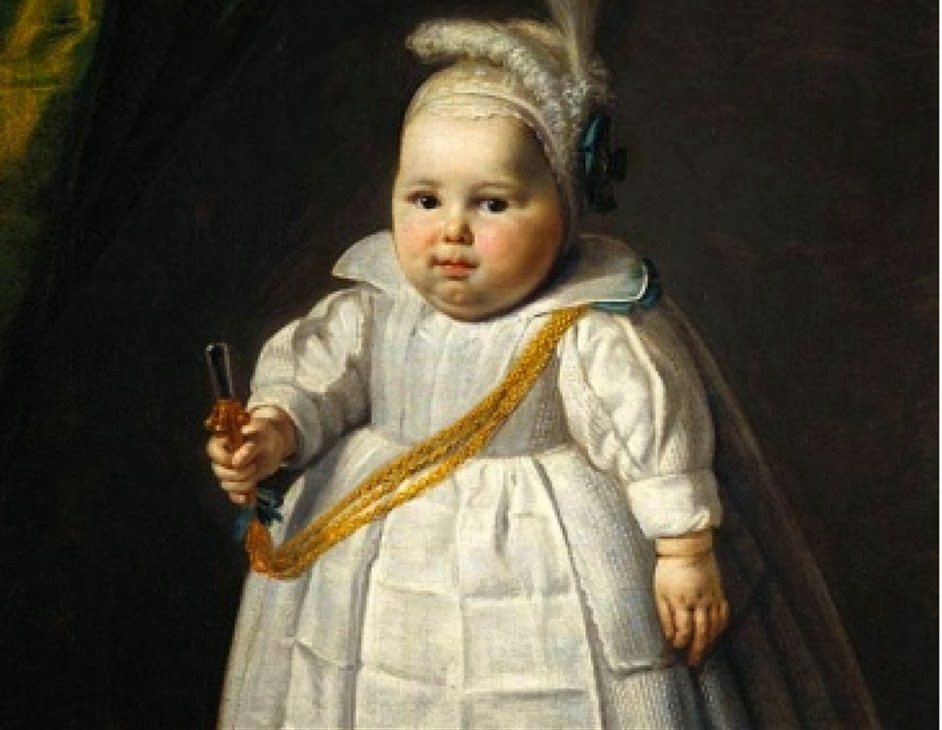
This delightfully plump baby wears
a dress so new that the crease marks
from folding are evident on the front.
Queen Elizabeth I's wards had the following daily schedule:
They went to church at 6 o clock, studied Latin until 11, dined from 11 to 12, had music from 12 to 2, French from 2 to 3, Latin and Greek from 3 to 5, then prayers, supper, and "honest pastimes" until 8, then music until 9, and so to bed.
Princess Elizabeth learned languages with the method of "double translation." She would translate a text, and then a couple of days later, translate it back to English and see how closely it matched the original. It was an activity she apparently enjoyed so much that she did it for fun in her adult years.

The child in the center is likely a boy,
judging by the sword strapped to his hip.
Poor children, of course, worked just like adults when they were physically able to do so. Some common children were able to go to parish schools and such, but only if their parents could spare their labor. Children were allowed to play, but it depended a lot on economic pressures and how closely their parents adhered to the notion espoused by advice manuals: that children should be "sober and sad" and devote their time to work, study and prayer instead of games.

Children were dressed in the same clothing as adults. Until age six or seven, a boy wore dresses modeled on those of his mother.

Some things never change. Commentators of the day suggested parents should not let kids choose their clothes because of children's foolish taste in fashion:


Let not children have their pleasures in the ordering of their garments. Some delight to have them jagged and cut; but such fantasticness ought to be reformed by wiser and elder, considering their foolishness is beyond measure, if all may be done at their pleasure; and ancient writers repute them out of their wits and madmen that favour it. Again, painted and gawdy apparel is not so fantastic in children's eyes ; but as costly to the parents purses, whereby ancient writers proclaim such parents fellow-fools with their children.

Being "breeched" signified the boy's passage into the male sphere of life, rather than a mother's care. The three ages of childhood were based on sevens. The first stage was infancy, the second stage was until age fourteen and was the main educational stage. After fourteen, the child was considered an adult in almost all respects, old enough for marriage.
StumbleUpon Share on Tumblr

Babies in the Tudor Era

The painting to the right is a very interesting artifact of the Tudor era. According to the Latin inscription in the upper right corner, it's a portrait of Cornelia Burch, age two months. It was painted in 1581 by an unknown artist.

We don't know who Cornelia was. It's been theorized that she was the daughter of Thomas, Lord Burgh, who was the English ambassador to Scotland, but there's no proof of it.

The painting is interesting for several reasons. Relatively few Tudor era infant portraits survive. Only about half of Tudor children survived to adulthood; a quarter of children did not reach their first birthday. And so commissioning an artist to paint an infant, especially an oil portrait such exceptional quality, was rare. Did little Cornelia survive to adulthood? There's no way for us to know.

Cornelia's family was obviously wealthy. The little cap on her head is frilled with fine, goffered linen. She holds in her hand a gold rattle with a polished tooth at the end. Her cradle is elaborately carved and she rests against a fine pillow. Her sleeves are of velvet, piped with gold. Her swaddling bands are silk, bound with gold cord.

But here's another interesting aspect: Cornelia is only half-swaddled. Her arms are free. Whether this was done simply for the portrait or whether it was her parents' choice to leave her arms unswaddled is unknown.

Parents swaddled their infants as their incomes would allow, but wealthy infants usually would have each limb individually wrapped in linen or silk, passing over the top of the head to keep it immobile, and then wider bands of cloth wrapped horizontally around their body. The child was unwrapped a few times a day to change their diaper, but otherwise handled as little as possible. It was thought too much attention would spoil them.

The portrait to the left is of the newborn Federigo di Urbino by Fiori Barocci, 1605. The baby's silk swaddling bands are embroidered with cloth of gold, and they wrap him from toe to shoulder like a little mummy. His head rests on a pillow decorated with pearls.


The two children to the right date to 1671, and are of a bit more modest means. They are bound up from head to toe in their swaddling bands, dressed over that in chemises with lace-edged collars, and then wrapped in white linen cloth, tucked neatly around their forms. Research into the family history of the infants suggests that they were twins, and unfortunately did not survive their first year.

The last portrait of swaddled infants I want to share with you is a very unusual image called The Cholmondeley Ladies, 1600-1610.

The image shows two ladies reclining in a bed, fully dressed in embroidered stomachers, sleeves with rosettes and pearls, elaborate ruffs, and jeweled necklaces. Both ladies hold a swaddled baby wrapped in a red christening gown. An inscription in gold lettering in the bottom left says the two women were sisters, born on the same day, married on the same day, and gave birth on the same day. An event worthy of being immortalized in oil paint, that's for sure!

Babies from wealthy families were usually given over to wet nurses to feed soon after the christening. Sexual relations were forbidden while a woman was nursing, and nursing naturally reduces a woman's fertility. Women of the day wanted to become pregnant again as soon as possible. There's an apocryphal story that Anne Boleyn wanted to breastfeed Elizabeth I, but her request was denied by Henry VIII. It's unlikely she would have asked.

The character of the wet nurse was very important, because negative character traits were thought to be transmitted in the milk. Nurses whose own children had been boys were favored. The milk of a woman who'd had a boy was thought to be more wholesome. She was to be given a rich diet foods, though with little spices, and red wine - thought to be strengthening. Sometimes, a wardrobe or other material goods were supplied to her. Elizabeth I's astrologer, John Dee, sent candles and soap to his child's wet nurse.

The image to the right is of Gabrielle d'Estrées, mistress of King Henry IV of France. A nurse is behind her, feeding Gabrielle's swaddled infant son César, born in 1594.

Children were generally nursed until the age of two, though I've seen mentions of children being nursed as late as five years old in the Tudor era.

They wore the long robes (christening gown length) until they were able to walk, when the child was officially "short coated." Both boys and girls wore gowns similar to adult women's clothing, and so it can sometimes be difficult to determine a child's gender in a portrait.

As soon as the child was old enough to walk and talk, they were old enough to begin the next stage of life, their education.

StumbleUpon Share on Tumblr

Love and Marriage During the Tudor Era

A good marriage during the Tudor era was one which brought prosperity to the family of the bride and groom. For the groom, it might be a good dowry and for the bride, advancement in status or in valuable connections for her family. The emotions of the couple involved were not really a consideration. They might never have met until they stood before the altar.

The higher up the social class, the less likely a person was to have choice in their spouse, and the younger they were likely to marry. Margaret Beaufort wed her first husband at twelve, the minimum age for a full marriage, according to the church.

When two families decided their children should wed, a period of negotiation began. The father of the bride was expected to pay a dowry commensurate to the bride's social status. This custom sometimes allowed the daughters of the gentry to "marry up" to cash-strapped nobles. The contract would also cover the jointure given by the husband, which was the funds and property allotted to the wife in case of her husband's death. This could also be an agreement which settled a portion of the dowry or husband's property for the wife's use during their marriage.

Tapestry showing the wedding of Arthur Tudor
to Katharine of Aragon
More than the marrying couple's future might depend on their marriage. Researcher Ralph Houlbrooke writes:

A father’s ability to provide for the rest of his children often depended upon his heir’s making the most advantageous match available to him. The connection can be seen quite clearly in a document like the will of Thomas Stonor (d.1431) who wished the proceeds of the sale of his son’s marriage to be used to marry his five daughters.

In practice, these agreements sometimes fell apart. Katharine of Aragon was left in a state of limbo after her young husband Arthur Tudor, died shortly after their wedding. Katharine's father and father-in-law bickered for years over the payment of her dowry. Mary Howard was another woman whose marriage agreement was never kept. After her husband, Henry FitzRoy died, his father, King Henry VIII decided that Mary should not inherit the estate because the union had never been consummated (on the king's own orders.)

Marriage was not intended to bring either party personal happiness. A couple hoped to come to an affectionate accord, but not romantic love, as we think of it. If a couple found love, that was a nice bonus, but not considered necessary for a successful marriage.

While he was still married to Katharine of Aragon, Henry VIII wrote in a song, "I love true where I did marry." Katharine, for her part, truly loved Henry. Perhaps the only one of his wives who did. It's doubtful she fell in love with him before their marriage, because they didn't meet very often. Hers was a love that grew over twenty years of marriage, bearing and burying multiple children, and raising together a daughter. Theirs, in other words, was the ideal union, except for Katharine's inability to give Henry the son he wanted so badly.

Not everyone saw this system of marrying children as a business matter as beneficial. The poet Thomas Heywood wrote:

How often have forced contracts been made to add land to land, not love to love? And to unite houses to houses, not hearts to hearts? which hath been the occasion that men have turned monsters, and women devils.
The wedding itself could be a simple affair. A legally binding marriage required only that the man and woman refer to themselves as husband and wife in front of witnesses.  (Katheryn Howard's marriage to Henry VIII was invalid because she was legally married to Francis Dereham for this reason.) Even stating the intention to marry was legally binding and required a dispensation from the Pope to break. Couples could also be married by proxy, having another person stand in for the bride or groom and take the vows for them. Princess Mary Tudor Brandon even had a proxy consummation of her marriage to the King of France by having a courtier touch her bare foot with his leg.

Sexual intercourse between a married couple was supposed to be for the purpose of begetting children only. The physical pleasure of the partners was part of that duty; it was thought a woman had to orgasm in order to conceive. Once she was pregnant, intercourse had to cease. Nor could the couple have sex during her times of menstruation.

Sex was also forbidden on Sundays, Wednesdays, Fridays, feast days, fast days, during Lent, during Advent, three days before taking communion, and during the daytime. There's a humorous flow chart that lists them. After childbirth, sexual relations were forbidden for about a month; some theologians proscribed a longer period after the birth of a girl than a boy. All told, the church forbid sexual relations roughly 40% of the year, not including a woman's menstrual cycle or childbearing.

Woman in childbirth, seated on a
"groaning chair"
Childbirth was a journey into the shadow of death for a Tudor woman. Some estimates of the number of women who died from complications of childbirth run as high as 20%. Two Tudor queens, who ostensibly had the best care money could buy, died from complications of childbirth: Jane Seymour and Elizabeth of York.

Noble and wealthy women usually turned their children over to wetnurses to feed. The church forbid sexual intercourse while a woman was nursing, and women were expected to get pregnant again as quickly as possible.

Parental distance from children was also encouraged. Affection would spoil the child, they were warned. And, as many probably felt, it was best not to get too attached, because of the high infant mortality.

A woman could fully expect to lose half of her children to childhood disease or accident before they reached adulthood, so large families were encouraged. Richard Fermor, whom is said to have brought Will Somers to court, is believed to have had ten children, only five of whom survived to be old enough to marry.
Ralph Josselin's diary entry on the death of his ten-day-old son illustrates the distance some parents tried to have with young children. He said that the boy, also named Ralph, "was the youngest and our affections not so wonted unto it."

Because of the expectation of losing children, names were sometimes repeated within a family's children, hoping one child would survive to carry it on. As an example, there were two brothers at the court of Henry VIII, both named Thomas Culpepper. (Because of the confusion, scholars are still uncertain to which brother to attribute certain actions.) Elizabeth Woodville had two sons named Richard. Chapuys heard as a rumor that Anne Boleyn was planning on naming her newborn daughter "Mary," which he felt was another of Anne's attempts to have her daughter usurp Mary's place, but even if Anne had re-used the name, it wouldn't have been unusual. Lord Hoo had two daughters by different mothers named Anne, and Elizabeth Howard had a half-sister also named Elizabeth.

It certainly makes for a challenge in research!


StumbleUpon Share on Tumblr