Lady Bridget Wingfield

Lady Bridget Wingfield was a close friend of Anne Boleyn at one time. But something happened between the two women, and Lady Bridget may have given testimony as she lay dying that was used against Anne in her trial.

It's unknown when Bridget was born. Some accounts say 1477, but that's almost certainly incorrect, because she was still having children as late as 1534. She was the daughter of Sir John Wiltshire, who had an estate that bordered the lands of the Boleyn family. Like Margaret Wyatt, Bridget may have known Anne from the time she was young, but there is no record of it.

Like many women of the era, the records of Bridget's life are scant. She first married Sir Richard Wingfield, who was Lord Deputy of Calais and an ambassador to France.

Sir Richard had an interesting life before he married Bridget. He had been the eleventh of twelve sons, raised at Kimbolton Castle. Being so low in the birth order and among so many sons, Sir Richard had to make his own fortune. He became a courtier during the reign of Henry VII, and married Catherine Woodville, Elizabeth Woodville's sister. She was the widow of Jasper Tudor, and sister-in-law to King Edward IV. A very advantageous match for Sir Richard. After her death, Sir Richard married Bridget. Their marriage was very fruitful, and Bridget had ten or eleven children with him.

Bridget came to court sometime before 1520 and was appointed one of Katharine of Aragon's ladies. She is recorded to have been at the Field of the Cloth of Gold, the famous meeting between Henry VIII and King Francis of France. Sir Richard had helped negotiate the meeting between the two kings.

Sir Richard was sent on a diplomatic mission to Spain in 1525, and fell ill of the "flyx," (flux, or diarrhea). His companions wrote home to the king:


PLEASITH it your Highnes to vnderstond that the xv th. day of this monith our company on Maister Wyngfeld, Chancelor of your Duchie fell syk in to a flyx, and the next day we were convided to a greate feste to the bishop of Avila, whider we went and Maister Wyngfeld with vs, thinking hymself strong ynough thervnto, where he dud ete Millons and drank wyn without water vnto them, and afterwardes dranke bere, whiche is made here by force bytter of the hoppe for to be preservyd the better agaynst the intollerable hetis of this contrye. And albeit he did ete but verey moderatly; yet after our retorne home not oonly his flux began to encreace vpon hym, but also the feuer toke hym farvently. Wherupon Phisicions were callyd for help, who after they perceyved the fever to bee contynuall without intermission and the flux to encrease to a voyding of blud, mynestred vnto hym suche medicynes as they thought moost convenyent; and after the Emperor, hering of his disease, sent all his Phisicions vnto hym to vysyte hym, but for no thing that all they cold doo, the fever could be remedyed, nor yet mean found to make hym slepe, or sleke his perpetuall and ardent thurst; wher vpon he made hym mete to God, and receyvyd all the sacramentis of holy churche, and the xx th day of this monyth whiche was Mary Magdalens day dipartyd owte of this transitory lyf...
[...]


A lytell before his dethe he wrote a Letter vnto your Highnes to pray the same to bee good and graciouse to my Lady his wif
[Bridget] and his childer, whiche your Grace shall receyue herwith. We have buried hym as honorably as we could devyse of things to be had here, bicause he was bothe of your Ordre and your Ambassador. His will was to bee buryed at the ffreres Obseruaunts, bilded in this Citie by the late King of Aragon and quene Elizabeth pro sepultura Regum, wher no man is buryed without lycence of the Emperor, for the opteynyng wherof after we sent to know his pleasure, he not oonly gladly gaue lycence but also comaundyd he shuld be buryed within the cyrcuit of the quere, which place is foundyd and reseruyd for bury all oonly of Kings. Whiche thinge he dyd in the honor of your Highnes, and never bifore was grauntyd to no pryvate person.


Sometime around this period, Bridget left court, and it seems she'd had some sort of quarrel or problem, though as to what it was, the records are silent. Anne Boleyn wrote a letter to Bridget, the only one of her letters to a woman friend which survives. It was written after 1525 when Anne's father held the title Viscount Rochford, but before his elevation to Earl of Wiltshire in 1529.

I pray you as you love me, to give credence to my servant this bearer, touching your removing and any thing else that he shall tell you on my behalf; for I will desire you to do nothing but that shall be for your wealth. And, madam, though at all time I have not showed the love that I bear you as much as it was in deed, yet now I trust that you shall well prove that I loved you a great deal more than I fair for. And assuredly, next mine own mother I know no woman alive that I love better, and at length, with God's grace, you shall prove that it is unfeigned. And I trust you do know me for such a one that I will write nothing to comfort you in your trouble but I will abide by it as long as I live. And therefore I pray you leave your indiscreet trouble, both for displeasing of God and also for displeasing of me, that doth love you so entirely. And trusting in God that you will thus do, I make an end. With the ill hand of

Your own assured friend during my life,
Anne Rochford


There's a current theory that Bridget was blackmailing Anne, but there's no evidence. We only know that Bridget's "indiscrete trouble" was upsetting to Anne, and she saw it as sinful, but she wanted Bridget to know she still cared for her.

Bridget remarried in 1529 to Sir Nicholas Harvey (or Hervey). Harvey was in favor with the king, and is mentioned in the chronicles of the day as a "diligent and faithful" servant. It probably helped that he was an athletic jouster, a sport highly favored by the king. Harvey is recorded as riding in the lists at the Field of the Cloth of Gold.

He must have been well-educated, because it's known that he spoke Flemish and French, which helped secure him an appointment as ambassador to Ghent. He was also known to be a "strong partisan" of Anne Boleyn and worked in foreign courts to advance the king's case for his annulment from Katharine of Aragon.

Harvey was out of the country quite a bit, but he and Bridget managed to have five children together, raising her total to a whopping fifteen or sixteen kids. He was recalled to England in 1532 to serve in Parliament, possibly to voice his support of the impending marriage, but Harvey didn't serve in that capacity for long. He died in August, 1532 at Ampthill, where Katharine of Aragon was being lodged at the time, leading some to speculate he had been sent to try to convince her to accept the inevitability of the king's marriage to Anne Boleyn.

In October 1532, Anne Boleyn and Henry VIII stopped to visit Bridget's home on their way to Calais. It would have been only a couple of months after the death of Bridget's husband. They stayed again on the return trip in November.

However, there seems to have been another unpleasant situation, and historians can only speculate as to what it was.

Bridget married for a third time to Sir Robert Tyrwhitt. Some theorize that Anne chastised Bridget for remarrying so fast after the death of her husband, or because Bridget had been acting inappropriately with Tyrwhitt even before Harvey's death.

Perhaps Anne simply disliked Bridget's choice of a husband, because Tyrwhitt was known to be hostile to Anne. Tyrwhitt supported Princess Mary, and was close friends with the Duke of Suffolk, husband of Mary Tudor Brandon, who despised Anne.

Shortly after she married Tyrwhitt, Bridget died, possibly in childbirth. 1533 was the last year she received a New Years gift, so it must have been sometime in 1534 that she passed away.

Two years later, during Anne Boleyn's trial, testimony was given that Bridget had given a confession about Anne Boleyn on her deathbed. One of the jurors, John Spelman, noted:

"Note that this matter was disclosed by a woman called the Lady Wingfield who was a servant of the said queen and shared the same tendencies. And suddenly the said Wingfield became ill and a little time before her death she showed the matter to one of her etc."

What that testimony was, we do not know, because the records of Anne's trial have vanished. Anne's letter to Bridget ended up in Cromwell's papers, possibly used as evidence to support the deathbed assertion.

There has been much debate over what Bridget could have confessed ... Possibly what she saw of Anne and Henry's sexual intimacy during their stay in her home on the visit to Calais. On the return trip, Anne and Henry were likely married, so they may have shared a bed beneath Bridget's roof. If she was not aware of the secret marriage, Bridget may have thought Anne was fornicating.

Or the testimony could have concerned Anne's relationship with Thomas Wyatt before she married the king. Thomas Wyatt seems to have believed that the Duke of Suffolk was responsible for his arrest, and may have thought the allegation came from Tyrwhitt's wife.

Bridget's testimony could only have been about Anne's life before she married the king. Bridget left court before Anne's marriage to Henry, so she could not have testified about the claims of incest and adultery Anne was facing in her trial.

But, in my opinion, the question should be whether Bridget made a "confession" about Anne at all. Why would a dying woman be primarily concerned with confessing the sins of another person, especially if they were activities which were already widely known, such as Anne and Henry's cohabitation on the Calais trip or Anne's relationship with Wyatt? If the information was important enough to trouble the mind of a dying woman, why did it continue to remain secret for another two years, until after Anne had already fallen?

Some have guessed it was because everyone was afraid to speak against Anne, but Katheryn Howard's sins only stayed secret for little more than a year after she married the king, and he was known to be more passionately in love with her than he had been with his other wives.

As I previously noted, Tyrwhitt was hostile to Anne, and the hope of her partisans was that if Anne was gone, Henry would restore Mary to favor. It could be entirely possible that Tyrwhitt exaggerated something his wife had once told him, or that he'd heard from gossip, in order to gain favor with the king who clearly wanted his wife out of the picture. Secondly, if Bridget did die of complications from childbirth, it's entirely possible she would have been delirious in the final hours of her life, and could have said anything.

None of the other witnesses to the trial report any explosive revelation coming from Bridget's testimony. Indeed, Spelman himself sums up all of the allegations: "all the evidence was of bawdery and lechery..." but apparently, not worth specifying. It's of particular interest to note that Spelman said Bridget "shared the same tendencies" as the queen. What tendencies was Tyrwhitt accusing his wife of having? A taste for adultery and incest? That seems unlikely. A tendency for flirtation? More plausible.

In the end, it seems Bridget's testimony was not a smoking gun, but another brick in the wall.


StumbleUpon Share on Tumblr

Deleted Scene: Will Tells Katharine of Henry's Re-Marriage to Anne Boleyn


There had been a knock at their door in the pre-dawn hours, and George Boleyn had whispered instructions to Will. When he left, Will closed the door and leaned against it for a long moment, hitting it softly with the side of his fist.

“I must go,” he said to Emma.

She climbed from the bed. “Where?”

“I cannot say.” Will seemed angry about that last point and Emma did the only thing she could do: pull him into her arms.

“It matters not,” she whispered. “As long as you return to me.”

He’d be gone for two days, he told her, three at the latest. They kissed at the door a long while before he left, and Emma tried to imprint upon her very soul his scent, his taste, the feel of his body pressed against hers. And she managed not to cry until he had shut the door behind him. Jack brought her a napkin to wipe away her tears and then sat and groomed her hair as she sobbed.

~,~

Emma would have liked the horse he was riding, Will decided. It was a sprightly, cheerful beast with bright eyes and a shiny, well-groomed coat. And though he felt a little foolish doing it, Will found himself talking to the horse as they rode along, and bizarrely enough, the horse seemed to listen to him, if the turnings of his ears were any indication. Perhaps the animal just liked the sound of his voice.

In any case, it made Will feel better to talk about Emma. She had seemed so much better since the return from the ocean, and then the bath he had managed to obtain for her. She had seemed so well he had considered asking her if the time was right for them to have a child, but then the king had sent him on this errand. The separation was hard enough on Will; how would Emma fare? He had terrible visions of her ceasing to eat, of pining for him, pining for the sea, grieving herself sick. It induced him to urge the horse to a faster pace, though the horse didn’t seem to mind.

The castle rose stark and forbidding in the distance. It was an ancient place, one Henry hadn’t renovated to the extent of his other palaces. He had stopped here on progress a few times to enjoy hunting in the nearby preserve, but had otherwise ignored it. Katharine was housed here now. It couldn’t be terribly comfortable for her, used as she was to massive palaces with ornate rooms decorated in the latest trends of opulence. This house was in a state of poor repair and the air was cool and damp, unhealthy for a woman in Katharine’s condition.

The steward who answered the door recognized Will and was welcoming. He was taken into the empty great hall and seated at a table with a jug of ale and a piece of bread and cheese to refresh him after his long journey. Will glanced around while he chewed, eyeing the dusty tapestries, the middling display of plate on the sideboard.

Near the fireplace, a small handful of ladies were embroidering a tapestry, all of them bent over the large frame. Katharine’s household had been reduced again when she moved here. Once, hundreds of ladies had served her. Now, it was down to a few dozen, smaller even than the household of a princess dowager, as punishment for her stubbornness. Katharine reduced that number herself by refusing to accept any lady who didn’t acknowledge her as queen. The rejected ladies stayed in the outer rooms of the house, spending their days embroidering and gossiping, some of them never having laid eyes on the woman they were ostensibly here to serve.

The women peered at him curiously. One of them giggled and whispered to her neighbor at Will’s hunched shoulder. He pointedly ignored them. He had the feeling if Katharine had been present, she never would have dared.

“Master Somers?” Elizabeth Darrell stood in the doorway. She curtsied to him and Will rose and bowed back to her.

“Mistress Darrell,” he replied. “ ‘Tis good to see you once more.”

“And you as well, Master Somers. What service may I do for you?”

“I have been sent to speak with your mistress.”

Elizabeth’s smile faltered. “She is not well today.”

Will took a deep breath. “I am afraid I must insist. I have a message from the king.”

She nodded. “As his majesty commands. Follow me.”

Katharine’s rooms were tucked away at the back of the castle, down dim and winding halls. Elizabeth carried a lamp with her to light their way and cautioned Will about the loose board in the doorway. He stepped over it into Katharine’s empty presence chamber. A chair sat on a dais under a cloth of estate, embroidered with the arms of Spain and Wales, Katharine’s coat of arms as a princess dowager. The chair was thickly coated with dust. Both of them bowed to it briefly as they passed into the privy chamber.

The room into which he was led was silent and dim. A pallet bed in the corner bore Katherine, a stout figure dressed in black. Her bed of estate was on the other side of the room, with rich hangings and fat pillows, crowned with that new coat of arms she detested. It would be like her to refuse to sleep in it.

Katharine rolled over and her face still wore that gentle, welcoming smile he remembered. “Master Somers!” she said, as though greeting an old friend. “Pray, forgive me that I do not rise. I trod on a pin, injuring my foot, and I have been sore annoyed with a cough.”

So sore she wasn’t wearing a shoe. He could see a hint of bare sole peeking from beneath her gown. A poultice had been applied to it, held in place by a thick linen bandage.

“Have you news for me of my husband?” she asked.

Will wished he’d drank more ale in the hall. He knelt next to her cot. “I do, Madame.” He took the paper of instructions from his pocket and opened it. He opened it slowly and reluctantly raised his eyes to her face. “The king’s majesty sends you word your marriage has been judged unlawful by the universities and by the Lords and Commons. The archbishop has pronounced it null and void, and the king’s marriage with Anne Boleyn to be sound and true.”

Katharine sucked in a breath that sent her into a coughing fit. Elizabeth Darrell hurried over with a goblet and she helped Katharine to sit up enough to drink it. Katharine choked on the liquid and Elizabeth murmured soothing words as she rubbed Katharine’s back. Elizabeth shot Will an angry look and he grimaced.

“I do not say this because I wish to,” he said, his tone pitched low to avoid the ears of the ladies who were undoubtedly listening at the door.

“Aye, that I know, Master Somers,” Katharine said between small coughs. “Pray, continue.”

Will dropped his gaze to his instructions. His hands had crushed the paper at the sides and he forced himself to loosen his grip. “By order of the king’s majesty, you are to abandon your pretended title of queen and content yourself with the title princess dowager. If you obey and show yourself to be a true and loyal subject of his majesty and his lawful wife, Queen Anne, you will be housed in comfort with the honor due you, and your daughter, the Lady Mary, will be permitted to visit once more.”

Katharine waited for a moment before she spoke. “Is that all, Master Somers?”

“Aye, madame.” Will couldn’t look at her.

“I thank you for delivering the king’s message to me,” Katharine said. Her voice was steady once again, warm and kind. He glanced up to her and saw she was giving him a small smile of understanding. She gestured to Elizabeth who brought over a small bag. “For your pains, Master Somers.”

Elizabeth handed the heavy pouch to him and he heard the coins clink inside. “Your grace,” he started, and then closed his eyes. “I cannot—“

“Pray, accept it in the spirit it was given.” Katharine’s smile was gentle and warm.

“Aye, Madame.” Will raked a hand through his hair in frustration. He cursed Henry for sending him on this task, to say hard words to this woman who had heard them before. Did Henry imagine Will would change her mind?

“I shall give you my reply now, and I ask you to convey it to my husband, the king.”

“I will, Madame.” Will looked up from the floor and saw something he would never be able to describe if he attempted to tell the tale to another. Like an invisible cloak, a mantle of dignity and power settled over Katharine. She was the infanta of Spain, the daughter of Ferdinand and Isabella, the descendant of generations of queens and kings. Royalty was writ in her blood.

“I am the king’s true and lawful wife, and there is no queen of England, save myself. The king may do what he will in his own realm, and the universities may say what they will, but there is none who might decide my case other than his holiness, the pope. I will not damn my soul by agreeing to the lie I am but the princess dowager. Nor will I illegitimatize my daughter, the rightful princess, Mary.”

She began to cough again and Elizabeth brought the goblet of wine to her lips. Katharine drank deeply and extended her hand. “May I see those instructions?”

Will handed the paper to her wordlessly. In truth, he was grateful to be rid of it.

“A pen,” she murmured to Elizabeth who fetched a wood box from a table on the other side of the room. She unhooked the clasps on the side and folded it out into a writing desk. Elizabeth uncapped the ink and dipped a quill into it. Katharine laid the instructions on the leather-covered surface of the table. Elizabeth brought the lamp closer and Will could read the words at the top of the paper, To the princess dowager, Katharine of Spain.

Katharine took the quill and slashed through the words savagely, tearing the point of the quill through the paper. She paused and closed her eyes for a moment. “Might I have your leave to make a copy of this document in Spanish, that I might send it to his holiness, the pope?”

“Aye, my lady.” Will could barely force out the words. Appeals to the Pope were now forbidden, but somehow, Katharine still managed to get letters smuggled out of the country, though little good they did her.

She smiled at him with that same gentleness and withdrew a sheet of paper from her desk. She wrote quickly, pausing now and again to re-dip the quill. When she finished, Elizabeth shook sand over the paper to dry the ink. Katherine folded it thrice and dripped some wax onto the edge of the paper, then pressed her ring deeply into it, creating an envelope with her signet seal.

Katharine held out the instructions she’d copied. “I thank you, kind sir.”

“Madame, I merit no title,” Will replied.

“Were it in my power any longer, I would see to it you got one.” She took a deep breath and coughed again, deep wracking coughs that shook her entire frame. “Prithee, convey to the king, my husband: I pray for him night and day, and the love I bear for him is why I stand firm in my convictions. I do this not from obstinacy, but to preserve the rights of my daughter, and care for my immortal soul will not allow me to lie.”

Will stood. “I will carry your words to him.”

Katharine held out a hand to him and Will took it, pressing a kiss to the back of it. “God’s blessings upon you, Master Somers. You have served your master well, but your heart is kind.”

Will thanked her and hurried from the room. His throat felt so tight it was difficult to breathe. A burning ball of anger seethed in his chest. Regardless of the legalities, of the religious implications, Katharine didn’t deserve this. And it left a chill in his bones, for if Henry could condemn the wife who had loved him for twenty years to this exile, torn from everyone she loved, what else could he do?

StumbleUpon Share on Tumblr

The Repose of a King: The Burial Place of Henry VIII

Anne Boleyn lies buried beneath the chapel floor of St. Peter ad Vincula. Her husband, Henry VIII, did not even provide a coffin for her. Nothing beyond a length of white cerecloth (waxed linen) for a shroud. So busy was he in planning his wedding to her successor, Jane Seymour, it's likely he didn't give her final resting place much thought. Her grave wasn't even marked until the restoration of the chapel in the Victorian era. It was an ignominious end, meant to erase Anne's memory.

Fate, it seems, has a sense of irony.

Henry planned a magnificent show for his own resting place. He had begun planning his tomb in 1518, during his marriage to Katharine of Aragon. His ego is writ large in every word of the plans. It was intended to outshine the resting place of every monarch in Europe. In 1527, a commission to work on Henry's tomb was offered to an Italian sculptor to the tune of 75,000 ducats, which is the modern equivalent of six million, ninety thousand pounds today. The total weight of the bronze needed to complete it would have been 35,000 pounds.

The tomb was to be built of black and white marble, the exterior covered with semi-precious "oriental stones." Atop each of its ten soaring marble pillars was supposed to be the life-sized figure of an apostle, and in the center, above its canopy, a life-sized figure of the king mounted on a large horse. Gold-covered brass figures of the saints were supposed to surround the recumbent effigies of the king and queen. Massive nine foot candlesticks, each held by the figure of a child, stood between the pillars. A grand altar in a side chantry chapel was planned, where masses for Henry's soul would be said for "as long as the world shall endure." You can see some recreations of the plans here.

Sporadic work was done over the years, based on the expenses recorded in the king's papers. When Wolsey fell, the king seized the materials of the tomb Wolsey was building for himself, including his black marble sarcophagus, and incorporated them into a new design for Henry's own tomb. The disgraced Wolsey ended up in a churchyard, beneath a slab that begs for a little earth for charity's sake.

Despite the three queens that came after her, Henry decided he wanted to be buried next to Jane Seymour. In his mind, she had been his best queen, the one who gave him a son - like she was supposed to - and she had been polite enough to die before he could get tired of her. The perfect woman. After her death, Jane's coffin was stored in a vault beneath the floor of St. George's Chapel, Windsor until the tomb could be completed and she could be interred next to where her husband would rest.

It's difficult to know at this point how much of the tomb was actually completed and how much was just in the planning stages. From what was sold off during the Commonwealth, we can make a calculated guess:

As regards the extent to which the work was actually carried out by Benedetto and his assistants, we may conclude that the podium and the sarcophagus with its base were placed in position; that only two out of the ten panels of the upper bronze frieze of the podium were cast and fixed in their places; that the lower frieze was complete, but that the two intermediate panels at one end of the podium, between the panels of the “frezes” were wanting; that the ten bronze columns were finished all except two, which wanted their capitals; that seven out of the ten statues of apostles had been cast and mounted on their columns; that only nine out of the thirty-four small figures about the bases of the columns were executed; that the closure was complete except as regards its gates; and that the principal statue, the recumbent effigy of the King, was probably cast and in its place on the top of the sarcophagus.
There is nothing to show whether any progress had been made with the altar beyond the making of the small pillars which had been designed for Wolsey, but without them sufficient work is accounted for to explain the comparatively large sum which the bronze fetched when sold as old metal at a forced sale during a time of civil war.

Perhaps the gargantuan cost was enough to make even Henry flinch, which is why completion was delayed. There also seems to have been a problem with the plans because the weight of the canopy could not be borne by the supports.

It's likely Henry thought he had plenty of time to complete his tomb, but at age fifty-six, his body was worn out from obesity, a possible diabetic condition, and repeated infections in his leg wound. His will decreed:

. . . and also by these presents, our last Will and Testament, doe will and ordaine, that our bodie be buried and enterred in the quire of our College of Windsor, midway between the stalls, and the high altar; and there be made and set, as soon as convenientlie maie be donne after our descease, by our executors, at our costs and charges (if it be not donne by us in our life time), an honourable tombe for our bones to rest in, which is well onward and almost made therefore already, with a fair grate about it, in which we will alsoe, the bones of our true and loving wife Queen Jane be put alsoe.

After the funeral, Henry's coffin was stored next to Jane Seymour's in the underground vault in St. George's chapel. It was meant to be a temporary burial until the tomb could be completed.

It seems his son, Edward VI, obediently had some work done on the tomb during his short reign, though his Protestant upbringing made him decide against having the masses said for his father's soul.

Young Edward died before much progress could be made on the tomb, and he didn't end up getting a tomb, either. Instead, he was buried beneath the altar of the Lady Chapel built by Henry VII. The grave was unmarked until 1966, when a tiny slab was put in place to mark the spot.

Work on Henry's tomb came a halt during the reign of Mary. Mary decided she didn't want to memorialize the man who had shattered England's relationship with the Catholic church, and the fact England was broke probably had a lot to do with her coming to that particular conclusion.

In 1556, after Elizabeth came to the throne, she had her treasurer draw up a report about what it would take to finish her father's tomb. She had all of the completed materials transported from their workshops to the side chapel known as Wolsey's "tomb house." But she nitpicked on the details and hem-hawed in that "answer-answerless" way of hers and just never quite got around to completing the tomb. She didn't build one for Mary, either - her sister ended up buried with her in Elizabeth's own tomb. (Which ended up being built by James, because Elizabeth didn't want people thinking too much about her death.)

The "tomb house" at Windsor was in a sort of curious limbo. Its upkeep and repairs were not the responsibility of the church to which it was attached, but instead was the responsibility of the crown. After the reign of James II, it fell into a state of neglect.

The vault where Henry and Jane's remains were stored was hastily opened in 1648 to inter the remains of Charles I after his execution. A year later, the Commonwealth government, in need of funds, decided to sell off the brass parts meant for Henry's tomb.

... in the chappel of Windsor Cathedral (sic) to be sold, and if the value exceed not six hundred pounds, then that money to be paid unto the Governor, Colonel Ven; who was so cunning, and had so much kindness afforded him by the Committee, as to have it sold for no more; and so he had that money besides other sums shared by the by, of which the Parliament were deceived. That monument which the Committee call brass defaced, was that curious, costly, elaborate tomb, erected at the immense charge of Cardinal Wolsey, intended for the memory of King Henry the Eighth, and so served the Cardinal’s design also for his own memory, as the redifying of St. Paul’s Church in London continues the monument of Laud, the Archbishop of Canterbury. The other was a piece of rarity, and sold for a song to a Dutchman, that made of it much more for the weight of brass.

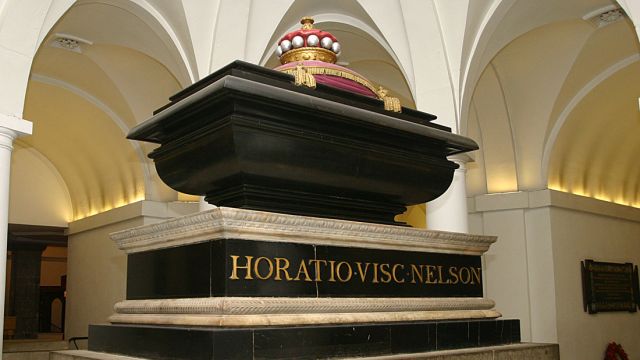
A couple of the candlesticks survive in a chapel in Ghent, Belgium. The black marble sarcophagus survived as well, and was eventually used to bury Lord Nelson.

The location of Henry's little vault was forgotten by the time of the reign of Charles II. (Perhaps they didn't look too hard, because it meant that Charles II could keep the money Parliament gave him for the erection of a tomb to commemorate the slain king.) By 1749, the "tomb house" was a ruined mess, with no windows, used for storing building materials.


Even as late as 1810 we find from the Annual Register, under date 26th October (vol. lii, p. 284), that “the building adjoining St. George’s Chapel, Windsor, called Cardinal Wolsey’s Chapel, was sometime since filled with lumber, although it had been understood that His Majesty intended to have a vault made there for the interment of the remains of his family; however, within these few days the lumber has been taken out of it, and the windows put in." In the Gentleman's Magazine for 1811 (p. 651) there is the following entry, "The Mausoleum at Windsor begun by Cardinal Wolsey has lately been finished agreeably to the directions of his present Majesty."

It wasn't until 1813 that Henry's vault was re-discovered. Sir Henry Halford wrote an account of the discovery, which is described as an accident caused by excavating under the "tomb house" in order to prepare a mausoleum there for the current king.

They opened the coffin with the lead plate identifying it as that of Charles I, removed the king's head to confirm it was really him and not an impostor's body as some rumors had it, and took some souvenirs. The people of that age were always delightfully ghoulish. In 1888, the vault was opened again to return the relics and a sketch was made of the interior.

They noted that Henry's coffin had been broken open and peeked inside. Inside was a skeleton, still bearing traces of a beard, which belie the old rumors that Mary had her father exhumed and burned as a heretic during her reign. The outer coffin of wood was badly decayed and all that remained was the lead wrapped around the body.

They thought the damage looked like it had been caused by an explosion from within, which matches up with one of the old stories of Henry's coffin bursting during the funeral rites and fluid leaking out. However, some of the damage could have occurred when Charles' coffin was shoved into the vault. The jumble of rubble behind that looks like wood could be from a stand or bier on which Henry's coffin was placed inside, that collapsed beneath the coffin's weight.

Jane's coffin was ignored and left undisturbed. The prince, who was in attendance, didn't think their mild curiosity was enough to justify disturbing her remains. They also discovered a tiny coffin resting on top of Charles', containing an unnamed infant child of Queen Anne (1665 – 1714).

The "tomb house" was eventually used by Queen Victoria to memorialize her beloved husband, Albert. Other kings and queens were laid to rest around Henry; most kings and queens since George III have been interred there in the Royal Vault, fittingly memorialized.

Henry's grave remained unmarked until 1837, when William IV took pity on the two kings who had no memorial whatsoever and had an inscribed slab installed on the floor to mark the spot.

In the end, Henry's resting place was no more grand than the resting spot of the queen whose memory he had sought to erase. He, too, lies beneath the floor of a chapel with no edifice erected above to memorialize him - only a slab in the pavement that bears his name.


StumbleUpon Share on Tumblr

Was Anne Boleyn a Bitch?

Traitor, whore, home-wreckerwicked stepmothermurderer...

Anne Boleyn has been given many labels over the years. But what is the actual evidence we have regarding her personality?

In the past few years, there have been some unsympathetic portrayals of her that paint her as a downright nasty creature. Is there anything to support this assessment of her character? What do we know of this girl with the "black and beautiful" eyes who set her country in a roar?

It's difficult to separate fact from fiction. Much of what we "know" about Anne comes from the reports of her enemies, who reported snippets of gossip as fact. Who knows how many layers of "the telephone game" the stories went through before they reached the ears of those who were eager to believe anything bad about her?

What we know about Anne is that she was very intelligent and charming, which made her a popular courtier. Her personality is probably is what drew the king's interest to her, not her physical appearance, which did not conform to the era's standards of beauty. With this charm stripped away from her in some modern portrayals of Anne as a nasty, disagreeable woman, you would be left wondering what the king saw in her at all!

Even as a child, she seems to have charmed those who met her. Margaret, the Archduchess of Austria, wrote to Anne's father after Anne was sent to Margaret's court:

I find her so bright and pleasant for her young age that I am more beholden to you for sending her to me than you are to me.

There, and at the French court, Anne learned manners, grace, and the courtly arts. The worst her enemies could say about Anne's manners were that they were "French." She was not known for rudeness, in other words, even to her enemies. Lancelot de Carles wrote of her:

For her behaviour, manners, attire and tongue she excelled them all.

Sir William Forest, who wrote poetry about Katharine of Aragon, described Anne Boleyn in this fashion:

Anne’s charm lay not so much in her physical appearance as in her vivacious personality, her gracefulness, her quick wit and other accomplishments. She was petite in stature, and had an appealing fragility about her … she shone at singing, making music, dancing and conversation … Not surprisingly, the young men of the court swarmed around her.

Anne would not have drawn people to her with a sparkling personality if she was an unpleasant, bitchy woman. Anne had many enemies because of her reformist faith and the Great Matter, but she also had many friends. Thomas Wyatt's grandson, who wrote a book based on his grandfather's memoirs, said that Anne had a sweet and cheerful demeanor:

She was taken at that time to have a beauty not so whitely as clear and fresh above all we may esteem, which appeared much more excellent by her favour passing sweet and cheerful; and these, both also increased by her noble presence of shape and fashion, representing both mildness and majesty more than can be expressed.

The Wyatt family seems to have cherished Anne's memory. They owned a small prayer book of Anne's that was supposedly given to Wyatt's sister, Margaret, on the scaffold before Anne's execution. The records don't indicate that Margaret was present at the execution, but she was known to be a good friend of Anne's at court.

She appears to have had quite a few women friends, despite portrayals of her as a vain creature who saw other women as competitors. Her only surviving personal letter is to a friend, Lady Bridget Wingfield, whom she says she loves more than any other woman in the world, aside from her mother.

As queen, Anne was polite and kind to the ladies who served her, and generous when they were in need. She made a secret loan to the Countess of Worcester of £100 - a vast sum that was still unpaid at the time of Anne's death - and paid for a midwife for the countess from her own privy purse in 1530. The countess would ultimately end up betraying Anne - some speculate the unpaid loan may have been a motive - but Anne is recorded to have worried about the countess's pregnancy while she was in the Tower.

Charity seems to have been a priority during Anne's short reign. She donated some £1500 per year according to George Wyatt, far more than her predecessor. She engaged her ladies in sewing clothing for the poor. Some paint this in the light of propaganda, but there's no way of judging sincerity through the ages.

Education was another one of her causes. Anne sponsored scholars, including John Cheke. It's known Anne argued with Cromwell about the funds from the dissolved monasteries, which she wished to use to fund schools, instead of going into the king's treasury or the pockets of the nobles. It's hard to paint this in a nefarious light, and so it's sometimes ignored by those who want to portray her as selfish and greedy.

A small snippet of Anne's personality comes through one of the stories she told while incarcerated in the Tower after her fall. When questioned about Mark Smeaton, the musician with whom she was accused of committing adultery, she said she thought she had only spoken to him once, aside from occasionally sending him requests to play certain music.

I found him standing in the round window in my chamber of presence; and I asked why he was so sad [...]

In the grand scheme of court life, Mark was a very minor servant, someone lowly and unimportant, but Anne was kind enough to take the time to talk with him.

[...] and he answered and said it was no matter.

Mark's response was very impolite at best. Instead of bowing and answering her question, as was proper, he sighed and said it wasn't important, because he was hoping she would be curious or flirtatious enough to coax it out of him and he could draw her into a conversation.

Anne immediately recognized this tactic for what it was. 

And then I said, “You may not look to have me speak to you as I should do to a noble man because you be an inferior person.” 

Anne's response wasn't as harsh as it sounds. In fact, it was far kinder than necessary. Instead of ignoring him or ordering him punished for insolence, she explained why she wasn't going to play the flirtatious game with him. As an "inferior" person so much lower in rank than she, he could not be so familiar with the queen. The queen was expected to flirt with her noblemen and have them pay her extravagant compliments. As a commoner, Mark was grossly overstepping his bounds by even attempting it. The best modern comparison is a janitor walking up to a CEO on the job, calling her "honey," and expecting her to respond in kind.

“No, no,” said he, "a look sufficed me; and thus fare you well.”

Mark's retort was even ruder than his previous comment. Not the part about the glance being sufficient, but the fact that he dismissed the queen. Anne's tolerance in this instance is noteworthy, because had she been so arrogant and vengeful as her enemies claim, she surely would have punished this shocking breach of decorum.

There's no doubt that Anne had a temper and was bold enough to express it, unusual for her day and age, and not a character trait that was admired. Today, her self-assertiveness wouldn't be seen as unusual, but in her day, it did her reputation no favors. Anne admitted at her trial that she had not always been as respectful to the king as she should have been, and if some of the outbursts attributed to her by Chapuys are true, she may have said some things in a temper that she later regretted. But haven't we all? If every word we said was recorded and repeated out of context, our utterances might not seem very pleasant at times.

When Anne was put in the Tower, an order was given that she was never to speak to the unfriendly ladies assigned to serve her without Lady Kingston present. What was the reason for this unusual order? The ladies had already been instructed to report every word she said to Sir William Kingston. Was someone afraid that Anne would charm the ladies into friendship and possibly interfere with the mission? An unpleasant person would not be a risk in that regard.

It's recorded that Anne Boleyn's ladies wept as though "bereft of souls" at her execution, and so some historians assume she must have been allowed to have her own serving women to replace the hostile ladies she had been assigned in the Tower. There's no record of it, however. If such a replacement was not made, those hostile ladies came to care deeply for Anne in the scant two weeks she was in the Tower before her execution. Either way, the women around Anne loved her enough to mourn her death.


Her last moments attest to her character. Kingston feared Anne would use her last words to declare herself "a good woman" in front of the crowd, but Anne obeyed convention. She said the usual words of the condemned, and submitted meekly. A bitchy person would have thrown convention to the winds and defiantly condemned the injustice that was happening to her, but Anne had manners and grace, even at the worst moments of her life, and regard for the future of her family.

In the moments before she died, the thousand or so people who came to witness her execution gave Anne a touching tribute. When she knelt for the stroke of the sword, the massive crowd knelt with her, falling to their knees in prayer around the scaffold. Such a thing is not recorded at any other execution of the era. I have a whimsical hope that she saw it.
StumbleUpon Share on Tumblr

Was Anne Boleyn a Victim of Sexual Harassment in the Workplace?

Karen Lindsey, author of Divorced, Beheaded, Survived: A Feminist Reinterpretation of the Wives of Henry VIII puts forth a very interesting opinion on the way we should view Anne Boleyn's time at court:

I was doing an article for Ms. about sexual harassment on the job and reading about Henry's wives in my free time, but it took a while to put together the fact that Ann Boleyn's position as lady-in-waiting to Henry's wife Catherine of Aragon was her job, and that, far from trying to lure Henry away from Catherine, she had spent over a year tactfully trying to repel his sexual advances. 
[..]
Today, Henry’s approach to Ann would be instantly identifiable as sexual harassment. Ann however, had no social or legal recourse against a the man who ruled the country. She continued, as so many women before and since have done, to dodge her pursuer’s advances while sparing his feelings. It didn’t work.
[...] 
It was a hellish position. Could she really tell the king to his face that she had no interest in him? She could reiterate her desire to keep her chastity and her honor, but clearly he didn’t respect that. She could ignore his letters and stay away from court, but he refused to take the hint. To offer him the outright insult he asked for would be to risk not only her own but her father’s and brother’s careers at court. She undoubtedly kept hoping he would tire of the chase and transfer his attentions to some newer lady-in-waiting.
But he didn't and she was trapped; there was no chance of her making a good marriage when every eligible nobleman knew the king wanted her.

Lindsey is correct that Katharine of Aragon's court was Anne's workplace. Service in a noble court was the 16th century's version of the corporate ladder.

The world of the nobility was a system of intricate social stratification where everyone sought employment from the rank above. The Babee's Book laid out this chain of service in example:

Even the duke's son preferred page to the prince, the earl's second son attendant upon the duke, the knight's second son the earl's servant, the esquire's son to wear the knight's livery, and the gentleman's son the esquire's serving-man. 

Those who were charming, talented, clever, or amusing, could be promoted with additional job duties and income, or move up to the household of a noble higher in rank. 

The duty of service to one's betters was bound up in religious faith. The Tudors believed that God had ordained the social order of the world. A person's status was the position to which God had called them, and so service to their superiors was as service to God.

Only those of the highest pedigree and social connections could hope to find a job serving the king or queen. Anne Boleyn was not titled, but she was the granddaughter of a duke. Her father was a very wealthy and well-connected man who had served as the king's ambassador, and Anne's mother had served Elizabeth of York. Securing Anne a job as a lady in waiting to Queen Katharine was a boon for their family.


Anne was employed in a series of royal households from the time she was a very young child, learning the social graces that would entertain those who employed her. She could dance, play instruments, engage in witty conversation, and was well-read enough to debate on intellectual topics. She was the consummate professional in her work, and remained chaste while she waited for her father to arrange a good marriage for her.

At one point, Anne took the bull by the horns and tried to arrange her own marriage with the son of the Earl of Northumberland. The results were disastrous, as far as her career was concerned. Once it was discovered what she was doing, she was banned from seeing the young man again and sent home to Hever in disgrace. She was fired, in other words.

Her family must have been livid. The match her father had been working on - perhaps unbeknownst to Anne - fell apart. Some scholars believe it might have had something to do with Anne's failed betrothal, but no records exist to explain it. The Butler family may not have wanted the union in the first place, which might have been engineered by Cardinal Wolsey to resolve an inheritance dispute. In any case, Anne now had no job, and no prospects for a husband.

Anne returned to court about a year later. We know nothing of the next two years or so, except what fragments can be deduced from the memories of Thomas Wyatt, as related by his grandson

There was, at this present, presented to the eye of the court the rare and admirable beauty of the fresh and young Lady Anne Boleigna, to be attending upon the queen. In this noble imp, the graces of nature graced by gracious education, seemed even at the first to have promised bliss unto her aftertimes. She was taken at that time to have a beauty not so whitely as clear and fresh above all we may esteem, which appeared much more excellent by her favour passing sweet and cheerful; and these, both also increased by her noble presence of shape and fashion, representing both mildness and majesty more than can be expressed.

She seems to have been very popular at court. Northumberland's son wasn't the only man who was attracted to Anne. Thomas Wyatt fell in love with her, according to his grandson's book, and several of Wyatt's poems seem to refer to Anne and his unrequited passion for her. But Anne was cautious of her reputation, and rejected Wyatt's advances.

King Henry seems to have noticed Anne in late 1525/early 1526. His favor came with a "promotion" offer for her: an appointment to serve his wife, Katharine of Aragon. Anne wrote the king a letter, thanking him for the appointment. But this promotion came with some drawbacks.

As Karen Lindsey notes, Anne was in a very delicate situation with Henry's favor. Having his interest meant her family's advancement, and indeed, her father and brother received a steady series of gifts, grants, properties and titles, including his long-desired title of Earl of Ormond. Anne herself was showered with gowns and jewels, and fawned over by the court, seeking her favor so she might help advance them as well. Rejecting the king outright would have cut off this flow, and perhaps even set the Boleyn family back to being worse off, if the king became angry about it.

  In February 1526, Henry made a public declaration of his interest in Anne, hoping the fawning attention of the court would pressure her into giving into his advances. Anne was suddenly thrust into the international spotlight as Henry's love interest, and suddenly had dozens of new "friends" seeking her favor and trying to use her for their own advancement. And, of course, they encouraged her to accede to the king's wishes. But Anne held firm to her principles. She would not sleep with any man outside the bonds of holy matrimony.

Henry now spent more time in his wife’s quarters than he had in years, but it was to visit Anne where she couldn’t escape his attentions.

In May, it got so bad that Anne actually quit her job as a lady in waiting and retreated to Hever, where she refused to answer Henry’s letters and sent back his gifts. Henry’s letters to her at this point are full of pouting complaints that she won’t write back to him. He claims not to understand it.

I cannot sufficiently marvel at, because I am sure that I have since never done any thing to offend you, and it seems a very poor return for the great love which I bear you to keep me at a distance both from the speech and the person of the woman that I esteem most in the world...

Henry still wouldn’t take “no” for an answer and chased after her. He went to stay with a cousin of Anne, Nicholas Carew, whose house was a convenient distance from Hever so he could ride over at his leisure. Anne could not refuse to receive him at the house. She refused wherever she had agency, but in this she did not. No one could refuse the king admittance.

When Anne did return to court, she had to face a great deal of hostility. Those still loyal to Katharine of Aragon despised Anne for "luring" the king away from his wife. Anne had enemies she'd never even met, people who hated her for everything she represented, who twisted her words and spread malicious gossip about her throughout Europe. Courtiers who smiled at her and bowed whispered behind their hands. Families were divided as religious reformers sided with the Boleyn faction, and the conservatives sided with Katharine.

But the greatest problem was that no man would seek Anne's hand in marriage while the king was pursuing her, certainly, and not after he lost interest, either. Few people believed Anne was still a virgin, and her reputation was in tatters around Europe. Around the time the king decided he wanted to marry her, Anne may have realized herself that she would marry the king, or have to remain unwed, a burden on her family. 

Thomas Boleyn has been portrayed as grasping and heartless, selling his daughters like a common pimp, but truthfully, he had little say in the matter, either. It wasn't only his fortunes at stake, but the entire future of the Boleyn family. If he'd had a choice, he probably would have wished Anne would give in and become the king's mistress, because Henry tended to find respectable husbands for the women he bedded once he was done. But Anne's religious convictions were too strong for that.

Anne was, indeed, trapped. She could not risk offending her "boss" and losing her job with her entire family's future at stake. Whether she liked it or not, she had to keep the king's favor. It was upward toward the throne or utter ruin. Anne Boleyn never really had a choice.


StumbleUpon Share on Tumblr