Showing posts with label Source documents. Show all posts

Erasing Anne Boleyn From History: The Documents

Very little documentary traces of Anne Boleyn remain. We know her mostly through the accounts of others - accounts that are often extremely hostile. Were her records destroyed intentionally, or by Time's indifferent hand?

Only a few of Anne's letters in her own handwriting still exist. A letter written to her father in 1514, and one written to Wolsey. We have the text of a handful of others, copied in the State Papers. Anne appears to have been a prolific correspondent, so this dearth of surviving copies would seem to indicate they were intentionally destroyed. This would not be unusual, since people would not want to be found with the letters of a convicted traitor among their papers.

We also have a letter, supposedly found among Cromwell's papers after his execution, which may be a copy of a letter from Anne Boleyn in the Tower. Historian John Strype, who had access to records which may have been destroyed in a fire in 1731, says he saw another letter from Anne in which she angrily rejected a plea bargain which would depend on her "confessing" and would stand on her innocence, even unto death.

There are very few records of Anne's trial. Only the salacious indictments and the verdicts survive. Contrast this to the numerous records concerning Katheryn Howard, which include interviews with witnesses, reports of the investigating commissioners, transcripts of testimony, and the written confessions of the accused themselves. That was just the investigation - Katheryn was never brought to trial.
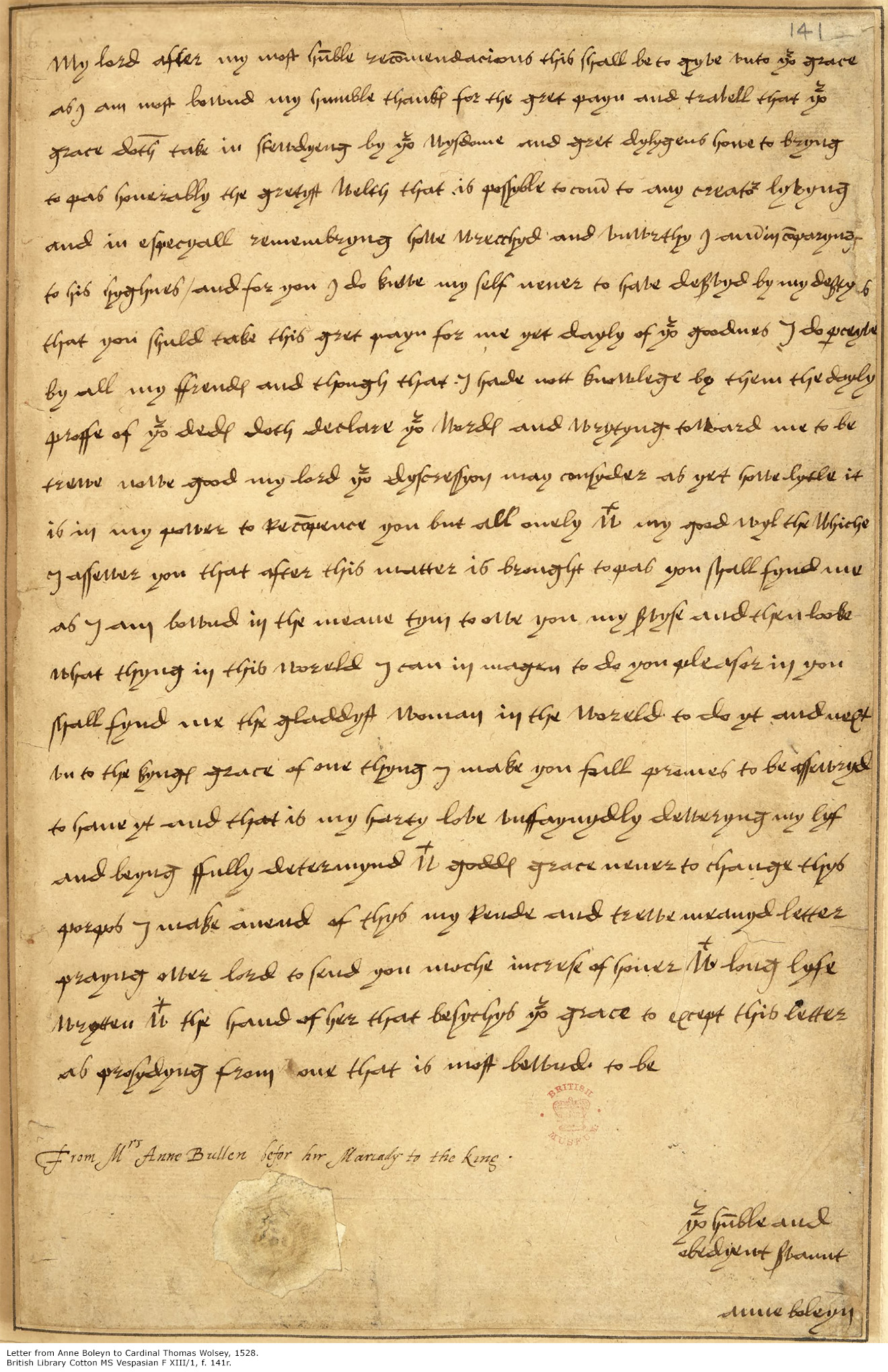
Image courtesy of Luminarium.org

Yet nothing like that from Anne's trial survives.

We know that there once were some more records, because they were examined by William Camden, who had access to the state papers of Elizabeth's minister William Burghley. It was Camden who confirmed some of the biographical details of Anne Boleyn which are still subject of debate by historians. It's assumed these papers were later destroyed, possibly in the 1731 Cottonian Library fire. What we lost is almost impossible to tell. But from the silence of the early historians, it's assumed that the trial records were already gone.

But if the records were - indeed - intentionally destroyed, who did it and why?

Historian David Starkey has put forth the theory that the documents never existed in the first place, that Anne was condemned primarily on verbal testimony that intentionally wasn't transcribed.

The theory explains why we don't know what Lady Bridget Wingfield supposedly confessed on her deathbed, or what was actually said by the Countess of Worcester when her brother confronted her. By contrast, Katheryn Howard's fall was a genuine investigation that generated paperwork as the investigators tried to determine what had happened, instead of a hasty frame-up to justify a pre-determined verdict.
A joint letter by Henry and Anne,
showing the scars of the 1731 fire

Another theory claims that Henry VIII and Cromwell had Anne's trial records quietly destroyed because they were trying to cover up the shameful lack of solid evidence against the queen, hoping the people of the future would take the indictment and verdict at face value. The purge supposedly occurred around the same time as Henry had Anne's portraits and emblems destroyed.

Yet another theory puts forth that Queen Elizabeth had the documents destroyed when she came to the throne to try to eliminate the evidence of her mother's condemnation. But why would she leave the salacious indictment intact, if that was the case? Elizabeth seems to have taken the position that the past was past, and left it at that. She seems an unlikely culprit.

All in all, Starkey's explanation, or a purge of documents by Cromwell seems the most likely to me.


StumbleUpon Share on Tumblr

The Age of Anne Boleyn: The Letter to Her Father

Courtesy of The TudorsWiki
One of the argument surrounding the birth date of Anne Boleyn concerns the letter Anne wrote to her father in 1514, thanking him for sending her to the court of Margaret of Austria, and pledging to be obedient daughter who would make the most of the opportunity.

Many people see this as evidence Anne must have been born in 1501 or even 1499, because the handwriting and French is too good for a seven-year-old girl.

I tend to disagree. As many scholars have noted, the letter's French is bad. Anne made several corrections, and in some places, the words are unintelligible. In other words, it looks more impressive than it really is.

This is the text of the letter, as translated by Philip Sergeant:

Sir, — I understand by your letter that you desire that I shall be a worthy woman when I come to the Court and you inform me that the Queen will take the trouble to converse with me, which rejoices me much to think of talking with a person so wise and worthy. This will make me have greater desire to continue to speak French well and also spell, especially because you have so enjoined it on me, and with my own hand I inform you that I will observe it the best I can.
Sir, I beg you to excuse me if my letter is badly written, for I assure you that the
orthography is from my own understanding alone, while the others were only written by my hand, and Semmonet tells me the letter but waits so that I may do it myself, for fear that it shall not be known unless I acquaint you, and I pray you that the light of [?] may not be allowed to drive away the will which you say you have to help me, for it seems to me that you are sure [??] you can, if you please, make me a declaration of your word, and concerning me be certain that there shall be neither [??] nor ingratitude which might check or efface my affection, which is determined to [?] as much unless it shall please you to order me, and I promise you that my love is based on such great strength that it will never grow less, and I will make an end to my [?] after having commended myself right humbly to your good grace.
Written at [? Veure] by Your very humble and very obedient daughter, Anna de Boullan.


Education in the Tudor era was much different than today. It started earlier, and the expectations were more stringent than today. Few allowances were made for a child's age. These methods were apparently successful, because noble children of the era are recorded as having remarkable accomplishments for their ages.

In the letter, Anne asks her father to pardon her mistakes because the letter is the first she has composed by herself, something unlikely to have been written by a fourteen girl. (In comparison, her daughter, Elizabeth, was writing flawless letters in Italian by age ten, and knew several other languages.)

Princess Mary Tudor could play the virginals well enough to impress ambassadors at age four. At age nine, she was able to converse with Flemish ambassadors in Latin. Edward VI could conjugate Latin at age seven, and kept a diary from the time he was ten years old. Prince Arthur Tudor and Katherine of Aragon exchanged polite letters in Latin from childhood. Lady Jane Grey began her education at age three and learned Latin, Greek, French, and Italian while corresponding with some of the greatest scholars of the age. Henry VIII's handwriting was very clear, even as a child, when he inscribed his Latin copy of Cicero. The Folger Library has examples of children learning handwriting that are very sophisticated to modern eyes.


This is a letter from the eight-year old Henry FitzRoy to his father, asking for a harness for his horse to aid with his studies of Julius Caesar.


Courtesy of the Scottish Archive for Schools
To the left is a letter that Mary Queen of Scots wrote to her mother in French - her second language - at about the age of eight. While its handwriting is not as stylish as Anne's, it is neat and well-formed. It was the same handwriting she would use as an adult.


To the right is a letter that was written by Princess Elizabeth when she was ten years old. It's in Italian and shows even better handwriting than that of Anne Boleyn. Granted, there is quite a difference between seven and ten, but Elizabeth supposedly knew several languages at this point, which presumably required years of study.

Anne apparently excelled in her studies, because Margaret found her exceptionally bright for her "young age." This comment indicates that Anne was younger than the usual accepted age of thirteen for maid of honor.

While it's not certain proof, I believe the letter would have been well within Anne's abilities if she had been tutored since she was a toddler, as most noble children were.
StumbleUpon Share on Tumblr

Source Documents

The Letters and Papers of the reign of Henry VIII.

Calendar of State Papers: Spain. Contains Chapuys's reports, sometimes with a slightly different translation than found in the L&P.

You can read about the Victorian restoration of St. Peter-ad-Vincula here.

The Life of Jane Dormer, Duchess of Feria. Dormer was a close friend of Mary I, and thus knows a lot of Mary's perspective on the events of her father's reign. She is also an ancestor of Natalie Dormer, who played Anne Boleyn in the HBO series The Tudors.

The Privy Purse expenses of Henry VIII, 1529-1532.

Life of Cardinal Wolsey by George Cavendish, which also contains Extracts from the Life of Queen Anne Boleigne, by George Wyatt.

Anne Boleyn: a chapter of English history, 1527-1536, Volume 1 By Paul Friedmann

Anne Boleyn's final purchases, between January 20, 1535 and May, 1536


Hall's Chronicle, by Edward Hall

Ecclesiastical Memorials by John Strype
StumbleUpon Share on Tumblr

"From the Lady in the Tower"

May 6, 1536.

Anne Boleyn is imprisoned in the Tower, accused of adultery, incest, and plotting the death of the king.

History buffs have long wondered if Anne wrote to Henry. Several movies and novels have gone further and envisioned Henry meeting with Anne in the Tower, as portrayed in Anne of a Thousand Days.

A letter exists, purportedly from Anne to Henry, dated only a few days after her arrest. The text is as follows:

Sir,
Your grace's displeasure and my imprisonment are things so strange unto me, that what to write, or what to excuse, I am altogether ignorant. Whereas you send unto me (willing me to confess a truth and so obtain your favor), by such a one, whom you know to be mine ancient professed enemy, I no sooner received this message by him, than I rightly conceived your meaning; and if, as you say, confessing a truth indeed may procure my safety, I shall with all willingness and duty, perform your duty.

But let not your grace ever imagine that your poor wife will be brought to acknowledge a fault, where not so much as a thought ever proceeded. And to speak a truth, never a
prince had wife more loyal in all duty, and in all true affection, than you have ever found in Anne Bullen—with which name and place I could willingly have contented myself, if God and your grace's pleasure had been so pleased. Neither did I at any time so far forget myself in my exaltation or received queenship, but that I always looked for such alteration as I now find; for the ground of my preferment being on no surer foundation than your grace’s fancy, the least alteration was fit and sufficient (I knew) to draw that fancy to some other subject.

You have chosen me from low estate to be your queen and companion, far beyond my desert or desire; if, then, you found me worthy of such honor, good your grace, let not any light fancy or bad counsel of my enemies withdraw your princely favor from me; neither let that stain—that unworthy stain—of a disloyal heart towards your good grace ever cast so foul a blot on me, and on the infant princess, your daughter. 
Try me, good king, but let me have a lawful trial, and let not my sworn enemies sit as my accusers and as my judges; yea, let me receive an open trial, for my truth shall fear no open shame. Then you shall see either my innocency cleared, your suspicions and conscience satisfied, the ignominy and slander of the world stopped, or my guilt openly declared. So that whatever God and you may determine of, your grace may be freed from an open censure; and my offense being so lawfully proved, your grace may be at liberty, both before God and man, not only to execute worthy punishment on me as an unfaithful wife, but to follow your affection already settled on that party for whose sake I am now as I am, whose name I could some while since have pointed unto—your grace being not ignorant of my suspicions therein.

But if you have already determined of me, and that not only my death, but an infamous slander must bring you the joying of your desired happiness, then I desire of God that He will pardon your great sin herein, and likewise my enemies, the instruments thereof; and that He will not call you to a strait account for your unprincely and cruel usage of me at His general judgment seat, where both you and myself must shortly appear; and in whose just judgment, I doubt not (whatsoever the world may think of me), mine innocency shall be openly known and sufficiently cleared.

My last, and only, request shall be that myself only bear the burden of your grace's displeasure, and that it may not touch the innocent souls of those poor gentlemen, whom, as I understand, are likewise in strait imprisonment for my sake. If ever I have found favor in your sight—if ever the name of Anne Bullen has been pleasing in your ears—then let me obtain this request; and so I will leave to trouble your grace any further, with mine earnest prayer to the Trinity to have your grace in his good keeping, and to direct you in all your actions.

From my doleful prison in the Tower, the 6th May.
Your most loyal and ever-faithful wife, Anne Bullen

You can see an image of the document here. And an authenticated letter in her handwriting.

There are questions as to the letter's authenticity. It was supposedly found among Cromwell’s papers after his execution. At the top, there is an inscription in what may be Cromwell’s own handwriting: “To the king from the lady in the Tower.”

The text of the letter, however, does not match other examples of Anne’s handwriting. Another problem is the spelling of the signature on the letter, "Bullen." It was an accepted spelling of her last name - it's spelled that way on her father's tomb - but Anne was rather consistent about spelling her last name either “Boleyn,” or “de Boulaine” when writing in French. After her father was ennobled, she signed her name "Anne Rochefort," and then "Anne Pembroke" when she attained her own title. After her coronation, she always signed her letters “Anne the Quene.”

At the time she was writing the letter, Anne was still Queen of England. Would she have signed the letter without reference to her title? Or, could it be, she wished Henry to recall the days when he wrote love letters to a young girl named Anne Boleyn?

There are a few historians who believe it was written by Anne. They argue it could have been dictated to one of her ladies, which would explain the handwriting and the spelling of her name. Some believe that the extant letter is a copy of a lost original, perhaps intercepted before it ever reached the king's eyes. Copyists were not consistent with using the same spelling as the original author.

We know the letter existed as early as 1649, when it was included in Lord Herbert's history of Henry VIII's reign. Many of the records were destroyed in a 1731 fire at the Cottonian Library, but they were examined by a historian, John Strype, prior to that date. He claimed to have seen a letter from Anne to Henry, written a few days after this one, in which she angrily rejected a plea bargain which would require her to confess, and would insist upon her innocence, even if it meant death.

I included a slightly paraphrased version of the letter "From the Lady in the Tower" in Under These Restless Skies because it’s what Anne should have said to Henry. It bluntly lays out the truth: Anne was innocent of the crimes she was accused of and she was being killed to make way for Jane Seymour.


StumbleUpon Share on Tumblr